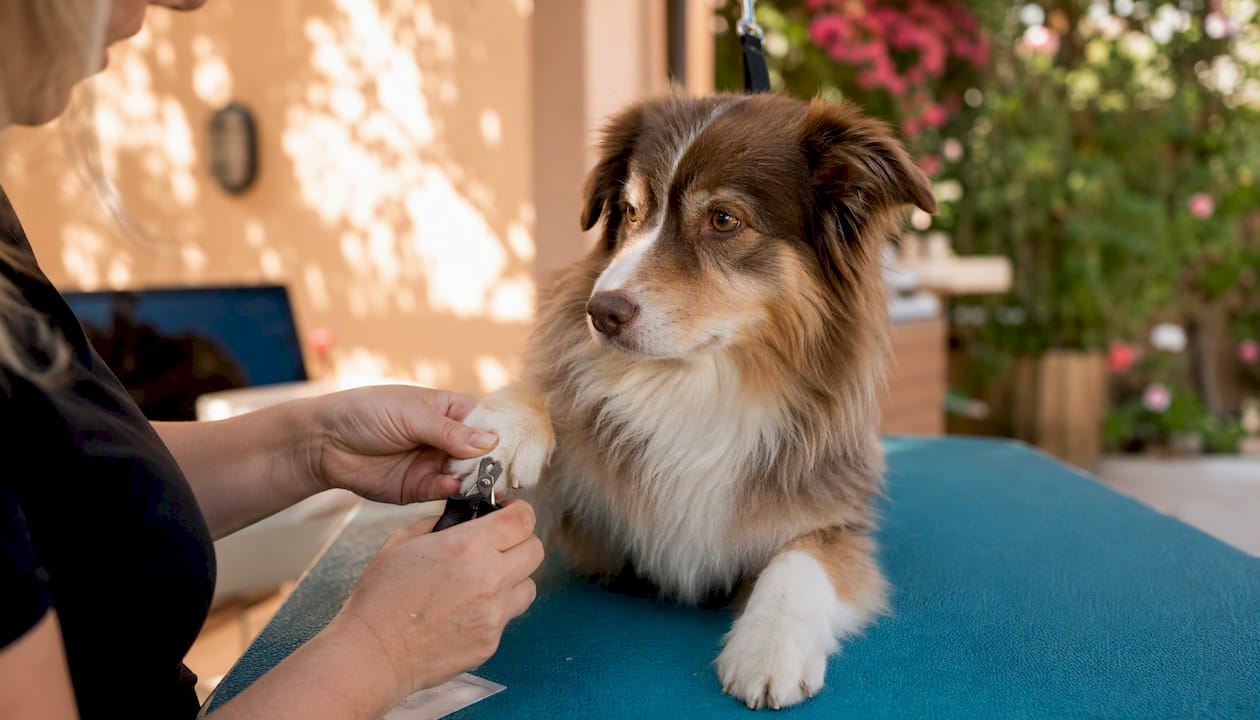

Most dogs need their nails trimmed roughly once a month, though the right interval for your dog depends on how active they are and what surfaces they walk on. VCA Animal Hospitals notes that once a month works as a practical baseline for many dogs, while Community Animal Hospitals recommends checking every two to three weeks for fast-growing nails. At The Pampered Pup, we see the full range — from dogs who need a tidy-up every two weeks to those who come in every six.
This week: Listen for a clicking sound when your dog walks across a hard floor. If you hear it, it’s time to trim.
Key Takeaways
Most dogs need regular nail trims about once a month, but activity level, walking surface, breed, and age all shift that interval, and the click test is your fastest weekly check.
| Point | Details |
|---|---|
| Baseline frequency | Most dogs need trims every 3–4 weeks; indoor or low-activity dogs may need every 2–3 weeks. |
| Surfaces matter | Pavement files nails naturally; sand, grass, and carpet do not, often requiring more frequent trims. |
| The click test | Nails clicking on hard floors mean it’s time to trim, confirmed by a standing and gait check. |
| Overgrown nails | Shorten gradually with small trims every 1–2 weeks; never cut to ideal length in one session. |
| The Pampered Pup | Cage-free, pet-paced nail trims in Mobile, AL — book online or call 251-776-2104. |
Table of Contents
- Dog nail trimming frequency: what changes your dog’s schedule
- How to tell when your dog’s nails need trimming
- How to shorten overgrown nails gradually and safely
- Safe trimming tools, technique, and grinder vs. clippers
- What to do if you cut the quick
- When a low-stress professional trim is the right call
- Gentle, cage-free nail trims at The Pampered Pup
- Sources
- FAQ
Dog nail trimming frequency: what changes your dog’s schedule
No two dogs wear their nails at the same rate. Understanding what drives that difference helps you build a schedule that actually fits your dog’s life.
- Activity level. A dog who runs on sidewalks daily files their nails naturally against the pavement. A dog who mostly lounges indoors loses that wear and grows nails faster in practical terms.
- Walking surface. Concrete and asphalt are the most abrasive surfaces. Sand, grass, and carpet offer almost no filing effect. Dogs in Gulf Coast areas often spend more time on soft sand or indoors during the hottest months, which tends to mean more frequent trims than owners expect.
- Breed and size. Large, heavy breeds put more pressure on their nails with each step, which can slow visible growth. Toy breeds and dogs with fine, fast-growing nails often need attention every two weeks.
- Nail growth rate. Some dogs simply grow nails faster. If you’re trimming on schedule and still hearing clicks within two weeks, shorten the interval rather than waiting for the full month.
- Age. Puppies need early, gentle exposure to nail handling. Senior dogs may slow their activity and need more frequent trims as a result, and their nails can become thicker and more brittle with age.
- Health and mobility. Dogs recovering from injury or managing arthritis often move less, which reduces natural wear. Their nails may need attention more often.
- Foot hair. Long hair around the paws can hide nail length entirely. If your dog has dense foot fur, part the hair before checking. Our blog on preventing matting between grooms covers how coat care and nail visibility connect.
Pro Tip: The “click test” is your fastest diagnostic. Walk your dog across a tile or hardwood floor. Clicking nails mean they’re touching the ground when they shouldn’t be. Combine that with a quick look at your dog’s stance: if the toes splay outward or the dog shifts weight to avoid pressure, the nails are likely overdue.
How to tell when your dog’s nails need trimming
You don’t need a groomer’s eye to spot overgrown nails. A one-minute weekly check covers everything.
- The click test. Walk your dog across a hard floor. Audible clicking is a reliable signal that nails are contacting the ground with each step.
- The standing check. Look at your dog from the side while they stand naturally. Nails should clear the floor slightly. If any nail touches the ground, it’s too long.
- The curl check. Look at each nail from the front. A healthy nail curves gently downward. A nail that hooks, curls sideways, or begins to spiral has been left too long.
- The gait check. Watch your dog walk. Reluctance on stairs, a shuffling gait, or toe-spreading can all point to nail discomfort.
- The split check. Run your finger along each nail. Fraying, splitting, or rough edges mean the nail has grown past a healthy length and may be catching on surfaces.
If your dog pulls away during the check, that’s useful information too. Sensitivity around the paws often signals that nails have been uncomfortable for a while. Start slow, reward generously, and consider a professional session to get back to a healthy baseline.
How to shorten overgrown nails gradually and safely
When nails have grown well past a comfortable length, the quick (the blood vessel inside the nail) has grown with them. You cannot safely cut back to ideal length in a single session. Attempting it causes pain, bleeding, and lasting fear of the grooming table.
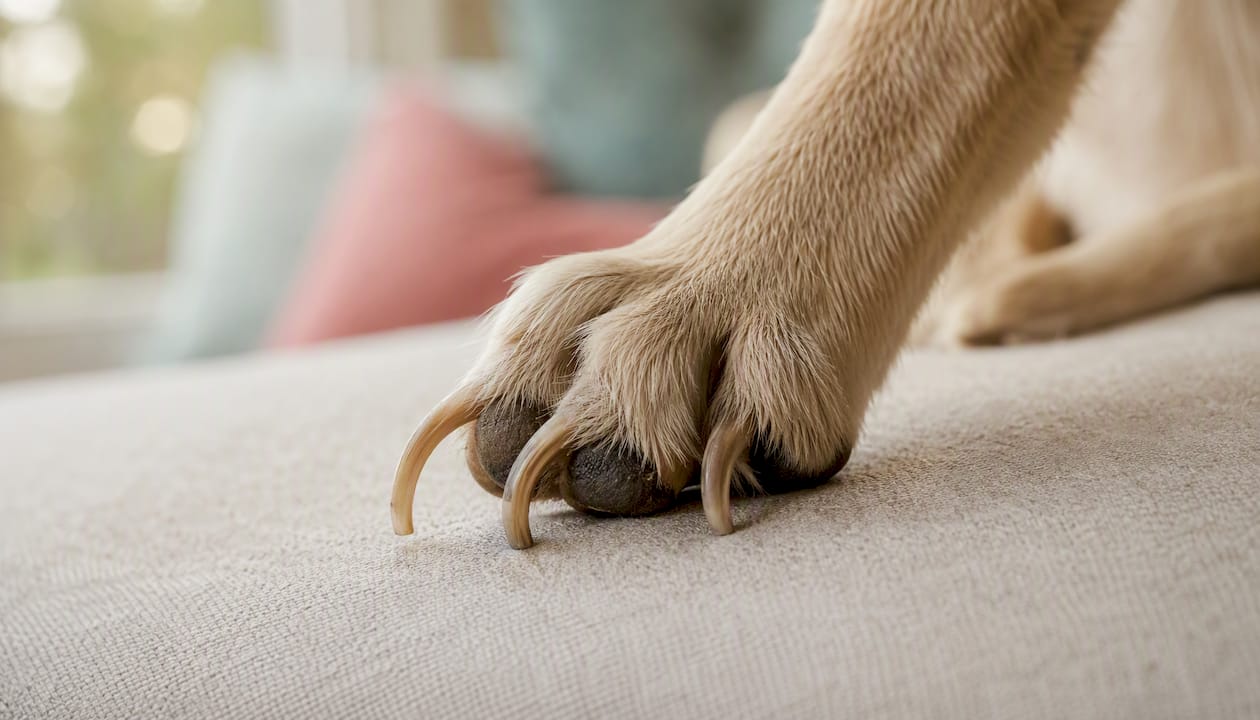
The safe approach is frequent, small trims that encourage the quick to recede over time. VCA Animal Hospitals confirms that for severely neglected nails, this process can take months of consistent effort, sometimes trimming every three to four days in the most extreme cases.
Here’s a practical protocol:
- Mild overgrowth (nails just past the floor line): Trim a small amount every one to two weeks. Most dogs reach a comfortable length within four to six weeks.
- Moderate overgrowth (nails curving or beginning to hook): Trim every seven to ten days, removing only the very tip each time. Expect six to ten weeks before the quick recedes enough for a normal length.
- Severe overgrowth (nails curling, causing gait changes): Trim every three to four days, taking only a sliver. This is the scenario where professional help is most valuable. A groomer experienced with sensitive dogs can manage the process calmly across multiple short visits.
Pause and reassess if your dog shows signs of pain, if bleeding occurs, or if the nail appears dark or discolored near the base. Those are signals to consult a veterinarian before continuing.
Pro Tip: Pair each short trim session with a short walk on pavement immediately after. The light abrasion helps smooth the nail tip and can modestly accelerate natural wear as the quick recedes. Keep sessions under five minutes and end on a calm, positive note every time.
Safe trimming tools, technique, and grinder vs. clippers
For most dogs, a quality pair of clippers sized for their breed is the right starting tool, with a rotary grinder kept on hand for smoothing rough edges.
Choosing your tool
- Scissor-style clippers work well for large breeds with thick nails. They offer more control and require less force than guillotine styles on dense nails.
- Guillotine clippers suit small and medium dogs with finer nails. They’re easy to position but the blade dulls faster and needs regular replacement.
- Rotary grinders smooth the nail after clipping and are excellent for desensitization work. Some dogs tolerate the vibration better than the snap of clippers. The noise and sensation do require patient introduction.
Step-by-step trimming
- Settle your dog on a non-slip surface. Have treats within reach before you pick up any tool.
- Hold the paw gently but firmly. Extend one nail by pressing the toe pad lightly.
- Identify the quick. On light nails, it appears as a pink core. On dark nails, clip small slivers and stop when you see a dark dot appear at the center of the cut surface — that dot is the edge of the quick.
- Clip at a slight angle, removing only the tip. Never try to reach the ideal length in one pass.
- Smooth the edge with a grinder or nail file if needed.
- Reward immediately after each nail, not just at the end of the session.
Grinder vs. clippers: a quick comparison
| Feature | Clippers | Grinder |
|---|---|---|
| Speed | Faster per nail | Slower, more gradual |
| Precision on dark nails | Harder to judge | Easier to control depth |
| Noise sensitivity | Quiet snap | Motor noise and vibration |
| Best for | Most dogs, all sizes | Anxious dogs, thick nails, smoothing |
Pro Tip: Start with just one or two nails per session if your dog is new to trimming. A two-nail session that ends calmly does more for long-term acceptance than a full trim that ends in stress. Build up over days or weeks, not in a single afternoon.
What to do if you cut the quick
Cutting the quick is one of the most common grooming mishaps, and it looks alarming. Stay calm. Your dog reads your energy, and a steady, quiet response helps them settle faster.
Immediate steps
- Apply gentle, direct pressure to the nail tip with a clean cloth or gauze.
- Press styptic powder or cornstarch firmly onto the nail end and hold for thirty to sixty seconds.
- Keep your dog still and quiet for a few minutes to let the clot form. Avoid letting them lick the nail.
- Check the nail after five minutes. Light bleeding that slows and stops is normal.
Supplies to keep in your grooming kit
- Styptic powder (the most effective option; available at most pet supply stores)
- Cornstarch or flour as a backup
- Gauze pads
- A small flashlight for checking dark nails before cutting
- Treats for immediate reassurance
Red flags that require a call to your vet or groomer
- Bleeding that continues past 20 minutes despite pressure and styptic powder
- Swelling, warmth, or discharge around the nail in the days following
- Your dog refusing to bear weight on the paw
- Signs of infection: redness spreading up the toe, odor, or visible pus
If any of these appear, contact your veterinarian. A single cut quick heals quickly in most healthy dogs, but an infected nail bed is a different matter entirely.
When a low-stress professional trim is the right call
Some dogs simply do better with a professional. That’s not a failure on your part — it’s good judgment. ASPCA Pet Insurance notes that many owners prefer professional services for safety and to reduce stress, and for fearful dogs or severely overgrown nails, that preference is well-founded.
A low-stress professional trim is the right choice when:
- Your dog shows fear, aggression, or extreme distress during home attempts.
- Nails are severely overgrown and need staged reduction over multiple visits.
- Your dog is a puppy building their first grooming associations.
- Your dog is a senior with thickened nails, arthritis, or sensitivity.
- You’re simply not comfortable with the process and want it done safely.
What to ask when booking a groomer
- Are nail trims performed in a cage-free environment?
- Do you offer pet-paced sessions, or do you work on a fixed time schedule?
- Can you handle elderly or sensitive dogs who need extra patience?
- Do you use positive reinforcement during the trim?
- Can we schedule a short introductory visit before a full session?
The answers tell you a great deal about whether a groomer’s approach will help or hinder your dog’s long-term comfort. A groomer who rushes, restrains heavily, or works in a kennel environment may get the nails done today but make the next visit harder.
At The Pampered Pup, our puppy and senior grooming services are designed around exactly this philosophy: short, calm, pet-paced sessions in an open, supervised space with no cages and no rushing. The Whole Dog Journal puts it plainly: short, frequent handling and a consistent maintenance program make trims easier over time and prevent the painful neglect that makes every future session harder.
A routine-first perspective on nail care
The conversation around nail trimming tends to focus on technique, and technique does matter. But the owners who struggle most aren’t struggling because they chose the wrong clipper. They’re struggling because the sessions feel like confrontations rather than routines.
Here in Mobile, the Gulf Coast climate adds a layer most guides don’t mention. Sand and soft soil offer almost no abrasive filing effect, and during the long, humid summers, many dogs spend more time indoors than their northern counterparts. That combination means Gulf Coast dogs often need trims more frequently than the national averages suggest, and owners are sometimes caught off guard when a monthly schedule stops working in July.
The philosophy we return to at The Pampered Pup is simple: short, frequent, and calm beats long, infrequent, and stressful every time. A two-minute session that ends with your dog relaxed and rewarded builds something a thirty-minute ordeal cannot. Patience is the real tool.
For owners who want to deepen their understanding of low-stress grooming, the Pampered Pup Grooming Academy offers apprenticeship-based education grounded in exactly this approach.
Gentle, cage-free nail trims at The Pampered Pup
When home trimming isn’t working, or when you simply want your dog’s nails handled with care and calm, The Pampered Pup is here. We offer professional nail trims and full grooming services in a cage-free, open environment where every dog moves at their own pace. No kennels, no rushing, no stress.
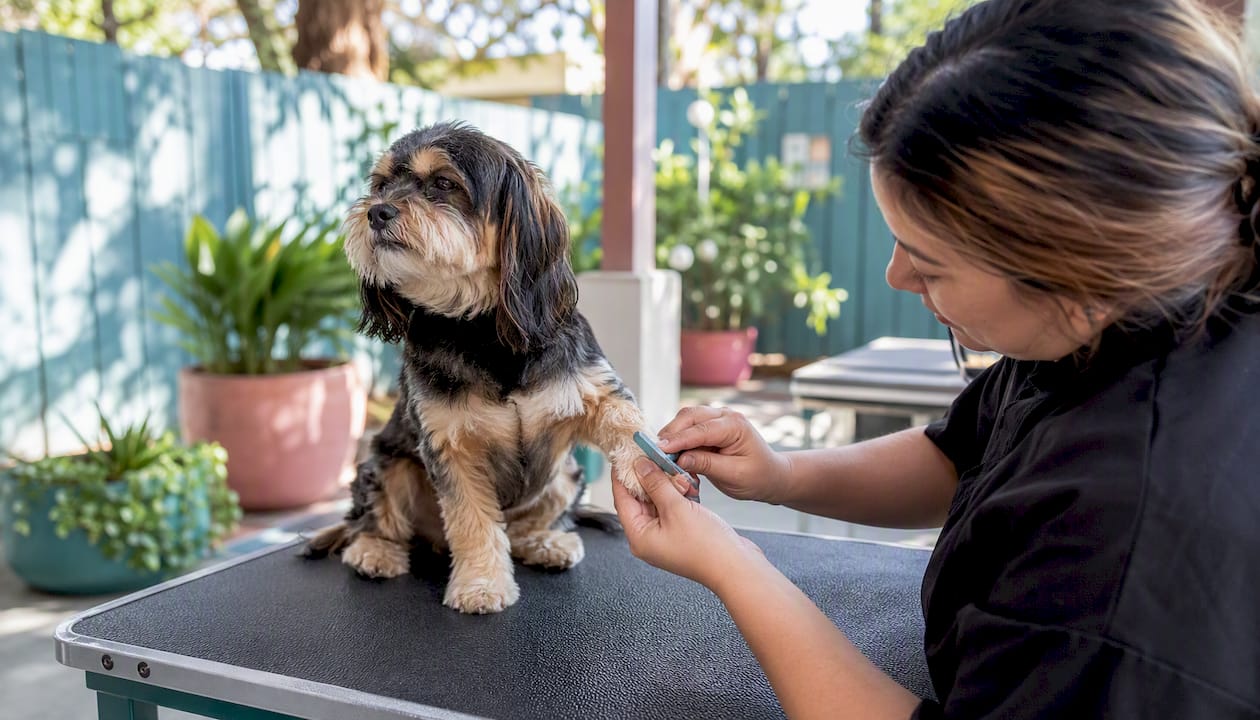
Our $19 Pampered Pup Package is a gentle starting point for owners who want a low-commitment, low-stress introduction to professional care. We also specialize in puppies building their first grooming memories and seniors who need extra patience and a soft touch.
We serve Mobile, Daphne, Spanish Fort, and Fairhope. Book online or reach us at 251-776-2104 to schedule a calm, pampering session for your dog.
Sources
- How to Trim a Dog’s Nails | VCA Animal Hospitals
- Your dog’s nails are probably too long — St. Pete vet advice
- Caring for Your Dog’s Nails
- The importance of clipping dog nails — Whole Dog Journal
FAQ
How often is it safe to trim a dog’s nails?
Trimming every three to four weeks is safe for most dogs; fast-growing or less active dogs may need attention every two weeks. Trimming more frequently in small amounts is always safer than waiting too long.
How long should you wait between dog nail trims?
Most dogs do well on a three to four week schedule, but the click test and a standing check are more reliable guides than the calendar alone.
Is it neglect to not cut your dog’s nails?
Yes, consistently overgrown nails cause real harm: they alter gait, stress joints, and can curl into the paw pad. Regular trimming is a basic part of keeping your dog comfortable and healthy.
Is it better to clip or grind dog nails?
Clippers are faster and work well for most dogs; grinders offer more control on dark nails and are gentler for anxious dogs. Many owners use clippers for the main trim and a grinder to smooth the edge.
Recommended
- How Often Should You Bathe Your Dog? A Mobile Groomer’s Guide | AL
- How Often Should You Groom a Doodle? | Doodle Grooming in Mobile, AL
- Contact & Book a Dog Groomer in Mobile, AL | The Pampered Pup
- Bath, Tidy-Up, or Full Groom? How to Know What Your Dog Needs | Mobile, AL
Want a hand with this? We're a cage-free, pet-paced grooming salon on Oak Circle Drive East in Mobile, AL, with early drop-off from 7:30 AM Tuesday through Friday (8:30 AM Saturday). Book online or call 251-776-2104 and we'll build a plan around your dog.