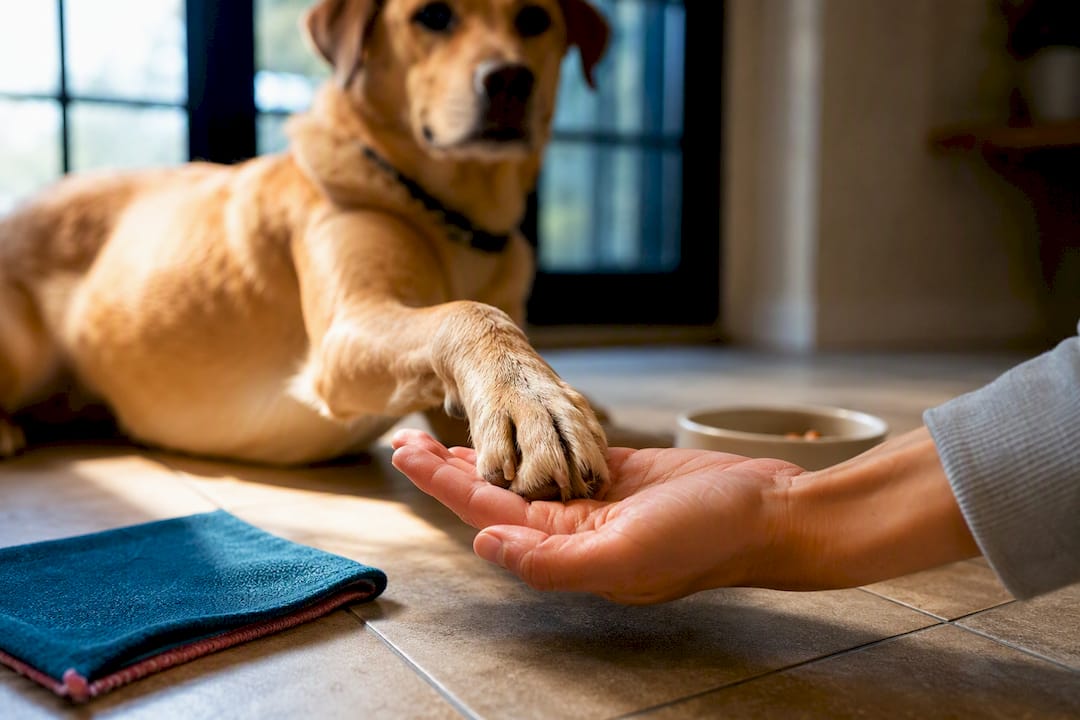

If your dog pulls away the moment you reach for a paw, start small and start now. Touch the shoulder, reward, then touch the paw edge for one second and reward again, stopping the instant you see stress. If you notice swelling, bleeding, a limp, or obvious pain, pause the training and call your veterinarian before doing anything else.
TL;DR:
- Paws are highly sensitive because of dense nerve endings, which can cause discomfort when exposed to heat, salt, or rough surfaces.
- Signs of medical issues include swelling, bleeding, limping, or constant licking, all of which require a vet visit before desensitization starts.
- Short, frequent training sessions that reward calm behavior are most effective for gradually building paw tolerance over two to four weeks.
- Introducing nail tools carefully involves desensitizing to sound and touch separately, starting with non-contact exposure and slowly working up to trimming.
- Maintaining routine paw checks, moisturizing, and avoiding hot pavement or salt residue helps prevent sensitivity and injury, supporting effective desensitization.
Table of Contents
- Why Are Dogs’ Paws So Sensitive to Touch?
- Signs, Medical Causes, and When to See a Veterinarian
- How Do You Desensitize a Dog to Paw Touching?
- How Do You Introduce Nail Clippers and Grinders Safely?
- Everyday Paw Care That Supports Desensitization
- Making Nail Trims and Grooming Visits Go Smoothly
- How The Pampered Pup Handles Sensitive Paws
- A Note on Patience From The Pampered Pup
- Ready for a Gentler Grooming Experience?
- Sources
- FAQ
Why Are Dogs’ Paws So Sensitive to Touch?
Paw pads carry an unusually high concentration of nerve endings, which is exactly what makes them so sensitive to touch, temperature, and texture in the first place, according to Whole Dog Journal’s breakdown of paw pad anatomy. Those pads are built to sense the ground beneath every step, so a light touch that seems harmless to us can feel intense to your dog.
Biology is only part of the story. Gulf Coast conditions add their own layer of irritation. Hot pavement in July, fine beach sand that works its way between the toes, and salt water from a Fairhope afternoon swim can all leave paws tender and reactive by the end of the day.
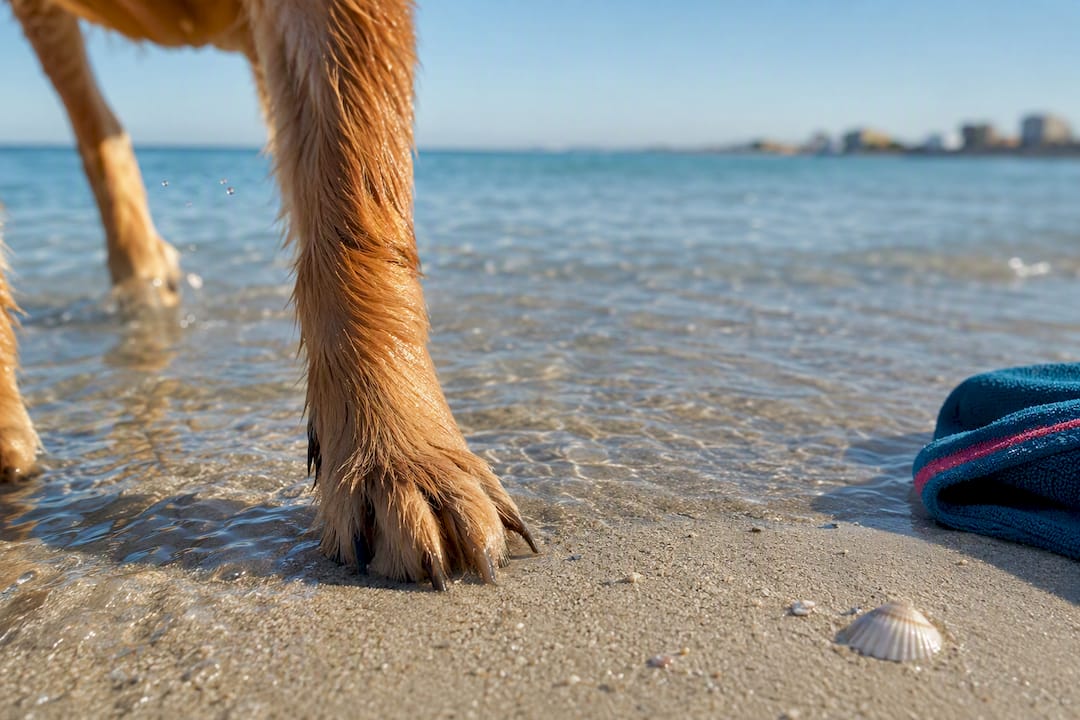
Behavior and history matter just as much. A puppy who was never handled gently, a dog who developed painful mats between the toes, or one who endured a rushed and uncomfortable nail trim in the past will often flinch at the first touch, even when nothing hurts anymore. That memory lingers, and it is one reason gentle, repeated, low-pressure handling matters so much for building trust back up.
Sand and salt exposure are common enough along the coast that routine paw checks after outdoor time are worth building into your daily walk, not just your grooming routine.
Signs, Medical Causes, and When to See a Veterinarian
Some paw sensitivity is behavioral, and some is medical. Knowing the difference protects your dog.
Call your veterinarian promptly if you notice any of the following:
- Visible swelling, redness, or heat in one paw
- Bleeding, an open wound, or a foreign object stuck in the pad
- Limping or refusing to put weight on a paw
- Constant, intense licking or chewing at one spot
Persistent licking deserves particular attention. It can point to allergies, infections, or parasites, and prolonged licking risks a secondary infection on top of whatever started it, according to WebMD’s paw care guidance. Interdigital cysts, cracked pads, and yeast or bacterial infections between the toes are also common culprits behind sudden paw sensitivity that has nothing to do with handling history.
If your dog shows any of these signs, a veterinary visit comes first. Training can resume once the underlying issue is treated and your dog is comfortable again. If there is no pain, swelling, or wound in sight, and the resistance seems rooted in fear or unfamiliarity, you can move straight into gentle desensitization work at home.
How Do You Desensitize a Dog to Paw Touching?
This is the heart of gentle paw care, and it works because it never asks your dog to tolerate more than they can handle in one sitting.
Keep every session short. Three to five minutes, once or twice a day, is plenty. Long sessions invite frustration for both of you, and frustration undoes progress. Desensitization and counterconditioning protocols that break handling into small, timed steps and reward after each one produce the most reliable results, according to guidance from Hawaiian Humane Society. The moment you see stiffening, pulling away, lip licking, or a low growl, stop and end on a calm note. Pushing past that signal teaches your dog that struggling works, which is the opposite of what you want.
Here is the progression we recommend, moving to the next step only once your dog stays relaxed through the current one for several sessions in a row:
- Touch the shoulder and leg, then immediately give a high-value treat. Repeat five to ten times per session.
- Slide your hand down to the paw edge without lifting it. Reward the instant you touch, then release.
- Lift the paw for one second, reward, and set it down gently. Repeat for several sessions before increasing duration.
- Hold the paw for three to five seconds, adding light pressure between the toes as your dog stays calm.
- Separate the toes briefly, as if checking for debris, and reward generously.
- Introduce a light squeeze near the nail bed, mimicking the pressure of a clipper, paired with treats.
Each step should feel almost boring in how small it is. That is the point. Dogs build tolerance through repetition at a level that never crosses their stress threshold, not through one dramatic breakthrough session, according to the VCA Animal Hospitals handling exercise guide.
Teaching a solid “shake” or “paw” cue speeds things along considerably. A dog who voluntarily offers a paw on command is already halfway to tolerating a trim, since the behavior puts them in control of the interaction rather than having a paw taken from underneath them.
Use treats your dog rarely gets otherwise: small pieces of chicken, cheese, or a favorite training treat work well. Save the ordinary kibble for ordinary moments, and reserve the good stuff for paw work.
Pro Tip: End every session while your dog is still comfortable, even if that means stopping after thirty seconds. A short session that ends calm builds more trust than a long one that ends in a struggle.
On timelines: most dogs show real improvement within two to four weeks of daily short sessions, though a dog with a painful history may need six weeks or longer. Progress is rarely a straight line, and a setback after a stressful week is normal. Consistency matters more than speed here.
How Do You Introduce Nail Clippers and Grinders Safely?
Equipment often frightens dogs more than the actual touch does. The sound and unfamiliarity of a grinder can undo weeks of paw progress if it is introduced too fast.
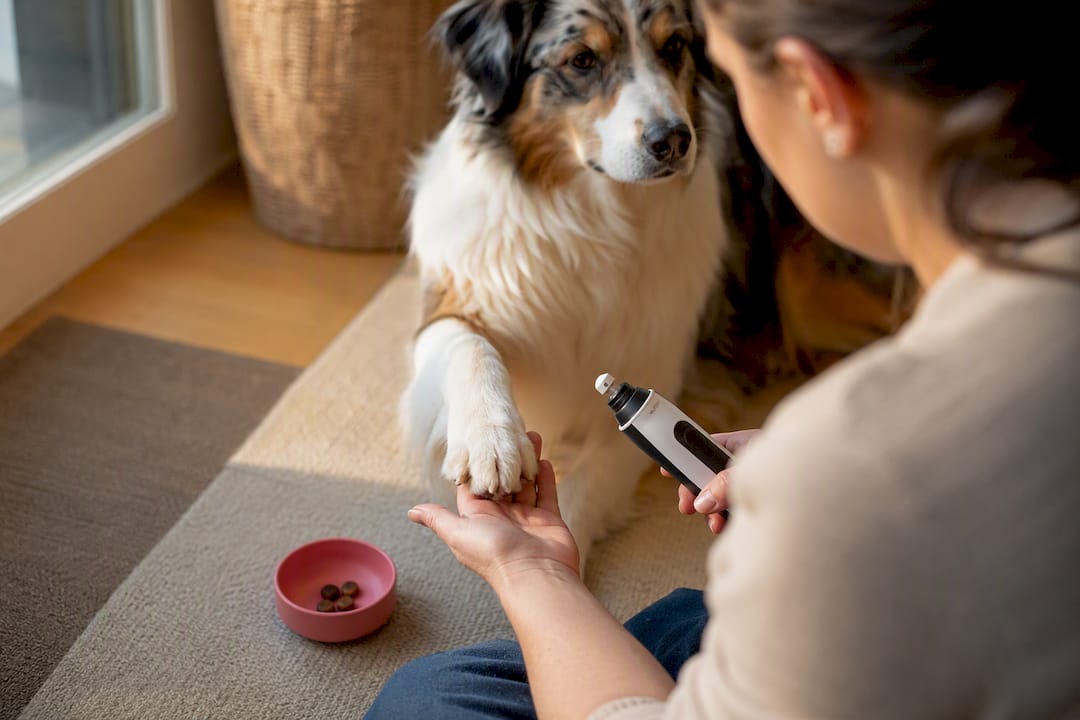
Start with sound alone. Run the clippers or grinder in another room, well out of sight, and reward your dog for staying relaxed. Many dogs need this kind of equipment-specific desensitization, and owners get the best results by pairing the sound with treats before the tool ever comes near a paw, according to Best Friends Animal Society.
Work through these stages before your first real trim:
- Let your dog sniff the still, powered-off clippers or grinder and reward calmly.
- Turn the tool on nearby (not touching), reward, then turn it off.
- Bring the running tool closer over several sessions, always rewarding calm behavior.
- Touch the running grinder briefly against a paw pad, away from the nail, before ever touching a nail itself.
- Trim or grind one nail per session at first, rewarding heavily, and stop there even if your dog seems fine for more.
Booties can help protect paws from hot pavement or salt residue, but most dogs need their own gradual introduction. Let your dog wear one bootie around the house for a few minutes at a time before expecting a full set on a walk. Some dogs never fully accept them, and that is fine. Paw balm or a quick towel wipe after a walk works as a reasonable substitute for dogs who resist booties altogether.
Everyday Paw Care That Supports Desensitization
A dog whose paws feel good is a dog who tolerates handling better. Paw care and paw training work hand in hand.
Check paws after every outdoor outing, especially after time on the beach or in the yard. Look between the toes for sand, burrs, or small pebbles, and rinse with cool water if anything seems stuck.
- Soak irritated paws in a diluted Epsom solution for a few minutes to soften dry or cracked pads.
- Follow with a vet-approved paw moisturizer, distracting your dog with a lick mat or a few minutes of gentle petting so the ointment has time to absorb.
- Rinse paws after any exposure to salt water or chlorine, since residue left on the pad can dry out the skin.
- In summer, test pavement with your own hand before a walk. If it is too hot for your palm, it is too hot for paws.
- In winter, wipe paws after walks on treated sidewalks to remove ice-melt chemicals.
Epsom soaks followed by a vet-approved moisturizing ointment can soften pads and help prevent cracking, though anything more than minor dryness calls for a veterinary look rather than a home remedy, according to The Spruce Pets. Along the Gulf Coast, where sand, salt, and heat are part of daily life for most of the year, that quick after-walk check becomes one of the simplest habits you can build to keep paws comfortable and touch-tolerant.
Making Nail Trims and Grooming Visits Go Smoothly
A calm trim starts long before the clippers come out. A little preparation goes a long way toward a stress-free visit, whether you trim at home or bring your dog in.
- Use the tiny-slices approach. Trim just the very tip of the nail, well clear of the quick, and stop after one or two nails if your dog seems tense.
- Tell your groomer about sensitivity in advance; many dog groomers offer pet-paced appointments tailored to your dog’s comfort. Mention paw handling struggles so the appointment can move at your dog’s pace rather than a fixed schedule.
- Ask about pet-paced options for puppies or seniors. A first groom or a senior appointment often benefits from extra time and breaks built in.
- Choose professional help when nails are overdue or dark-colored. Long-overdue nails and dark nails, where the quick is hard to see, are safer left to a trained groomer.
Preparing your dog with even a few weeks of the touch and lift exercises above, before a scheduled appointment, makes the professional visit shorter and calmer for everyone involved. You might also look at how nail trim frequency affects sensitivity, since nails that grow too long change how a dog bears weight and can make paws more reactive to touch over time.
How The Pampered Pup Handles Sensitive Paws
At The Pampered Pup, every groom happens in an open, cage-free space, at the pace each dog needs. There are no cages, no rushing, and no kennel stress waiting between steps.
Our sensitive-dog grooming, puppy first grooms, and senior grooming services are built around exactly the kind of gradual, reward-based handling described above. A groomer trained through our own apprenticeship program, the Pampered Pup Grooming Academy, learns to read a dog’s comfort level before ever reaching for a clipper.
For a first sensitive-dog appointment, expect a groomer who introduces tools slowly, pauses when needed, and treats your dog’s comfort as the priority over the clock. You can also read more on our approach to grooming reactive dogs for a closer look at how we handle dogs who need extra patience.
A Note on Patience From The Pampered Pup
Progress with sensitive paws rarely happens in a single week, and we would rather see slow, steady trust than a rushed result.
The dogs we see along the Gulf Coast deal with sand between their toes, salt water drying out their pads, and humidity that never really lets up. All of that adds friction to an already sensitive area, so a little extra grace goes a long way.
Watch your dog closely during every session. The moment you see stress, stop there. Ending on a calm note, even after just a few seconds of handling, teaches your dog that this process is safe, and that lesson is worth more than any single trim.
— Martha Traweek
Ready for a Gentler Grooming Experience?
The Pampered Pup offers what a rushed, cage-based grooming visit cannot: a cage-free, pet-paced session where a sensitive dog is never hurried through a trim they are not ready for.
Our sensitive-dog grooming, puppy first grooms, senior grooming, and tidy-up trims are designed around exactly the calm, gradual handling described in this guide. When you book, simply let us know your dog struggles with paw handling, and we will build breaks and extra time into the appointment.
New clients are always welcome to start with our $19 Pampered Pup Package to introduce your dog to our space before a full groom. You can review our full range of grooming services for sensitive, puppy, and senior dogs, or check what to expect for your dog’s specific coat and breed on our breed-specific grooming page.
Ready to book? Visit us online or call 251-776-2104 to schedule a serene, pet-paced appointment for your dog in Mobile, Daphne, Spanish Fort, or Fairhope.
Sources
- Handling Exercises for Trimming Nails and Brushing Teeth | VCA Animal Hospitals
- What You Need to Know: Dog paw pad anatomy | Whole Dog Journal
- Handling and touch sensitivity (Hawaiian Humane PDF)
- Best ways to soften dog paws | The Spruce Pets
- Paw care tips for dogs | WebMD
FAQ
Why are my dog’s paws so sensitive to touch?
Paw pads have a dense concentration of nerve endings built to sense ground texture and temperature, which makes them naturally more reactive to touch than most other parts of the body, according to Whole Dog Journal.
What is the 3-3-3 rule for dog anxiety?
The 3-3-3 rule is a general guideline for helping a newly adopted dog settle in over three days, three weeks, and three months. It is not a specific paw handling protocol, though the same patience it calls for applies directly to desensitization work.
What can I do to soothe my dog’s irritated paws?
A brief Epsom soak followed by a vet-approved moisturizer can soften dry or cracked pads, and distracting your dog with a lick mat afterward gives the ointment time to absorb, according to The Spruce Pets. Persistent irritation or licking calls for a veterinary check rather than home care alone.
How do you desensitize a dog to paw touching?
Start with brief, reward-backed touches at the shoulder and work down to the paw in tiny steps, stopping the moment your dog shows stress and progressing only when they stay calm through several sessions. Most dogs show meaningful improvement within two to four weeks of short, daily sessions, and services like sensitive-dog grooming at The Pampered Pup use this same gradual approach in a professional setting.
Recommended
- Dog Beach Grooming: What Coastal Dog Owners Need to Know
- Grooming Reactive Dogs: A Calm, Safe Approach
- Senior Dog Grooming: A Safe, Gentle Guide
- Summer Coat Care in Mobile, AL: Should You Shave?
Want a hand with this? We're a cage-free, pet-paced grooming salon on Oak Circle Drive East in Mobile, AL, with early drop-off from 7:30 AM Tuesday through Friday (8:30 AM Saturday). Book online or call 251-776-2104 and we'll build a plan around your dog.