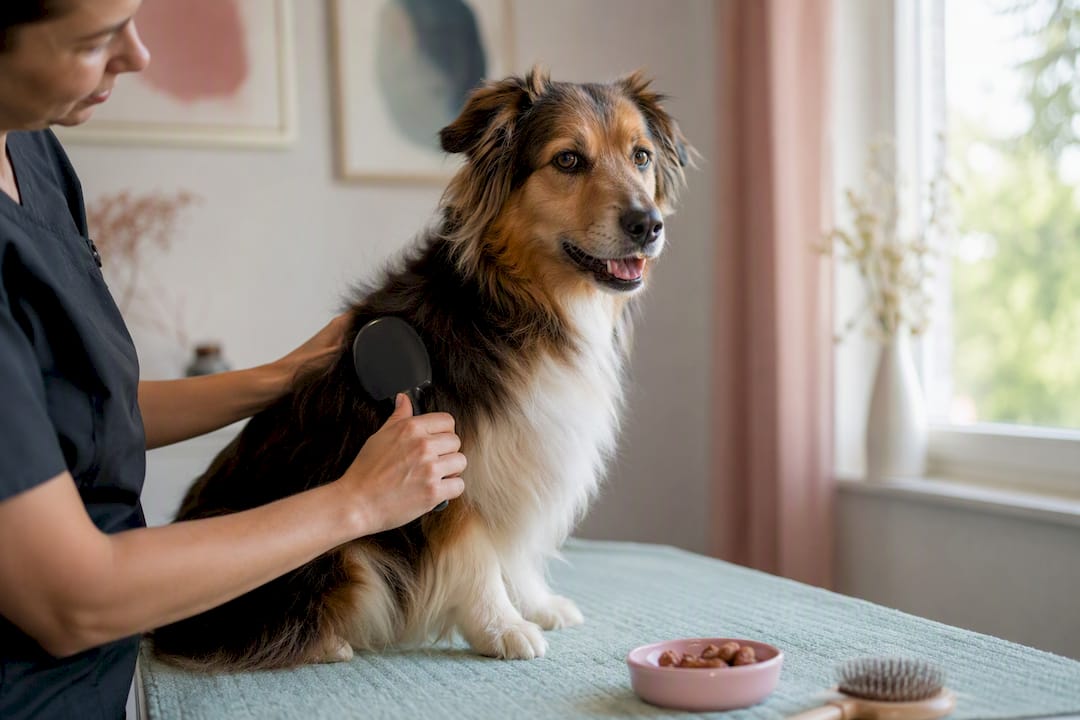

The fastest, safest way to handle anxious dog grooming is a short reward-based grounding routine paired with a minimum-viable groom, then a longer cooperative-care and desensitization plan for the weeks ahead. Groomers and behavior professionals, including those following cooperative care principles, agree that forcing a full session on a frightened dog usually backfires. Start smaller. Stop sooner. Build trust first.
Immediate actions to use right now:
- Lower your voice and slow your movements.
- Remove clippers, dryers, or tables from view if the dog is already spooked.
- Offer a tiny, high-value treat like cooked chicken.
- Pause for thirty seconds before deciding whether to continue.
- End the session early rather than push through fear.
Pro Tip: A “minimum viable groom” (just paws and a sanitary trim, for example) beats a forced full groom every time. Partial progress builds trust for next time.
Key Takeaways
Anxious dog grooming improves fastest when owners combine immediate calming steps with a structured cooperative-care and desensitization plan over several weeks.
| Point | Details |
|---|---|
| Start small | Use a minimum-viable groom and reward-based grounding before attempting a full session. |
| Read clusters, not signals | Lip licking, yawning, and a tucked tail together warn of stress better than any one cue. |
| Follow the protocol in order | Touch, treat, then tool introduction, always with treats timed to the stimulus. |
| Expect a real timeline | Mild cases often ease in 2–4 weeks; severe cases may need three to six months. |
| Choose pet-paced care | The Pampered Pup offers cage-free, minimum-viable grooms for dogs who need a gentler start. |
Table of Contents
- What Does Anxious Dog Grooming Look Like?
- How Do You Calm a Dog Mid-Groom?
- How Do You Desensitize a Dog to Grooming?
- What Is Cooperative-Care Grooming?
- How Do You Introduce Grooming Tools Safely?
- How Should You Prepare for a Grooming Appointment?
- When Should You Call a Vet or Behaviorist?
- How Long Does It Take to Fix Grooming Anxiety?
- What Are the Safety Rules for Grooming at Home?
- What Does Cooperative, Pet-Paced Grooming Look Like in Practice?
- A Calm Note From The Pampered Pup
- How The Pampered Pup Supports Anxious Dogs
- Sources
- FAQ
What Does Anxious Dog Grooming Look Like?
Grooming anxiety rarely shows up as one dramatic moment. It builds through small, quiet signals that are easy to miss if you’re focused on getting through the appointment.
Watch for lip licking, yawning outside of tiredness, “whale eye” (when the whites of the eyes show), a tucked tail, freezing in place, or trembling. On their own, any of these could mean nothing. Together, they tell a clear story. Research on reading stress signals during grooming confirms that clusters of subtle cues are far more reliable warning signs than any single behavior.
Some dogs skip the subtle stage entirely and go straight to snapping, thrashing, or trying to bolt. Others do something more worrying: they go still and quiet, and owners mistake this for calm cooperation.
A dog that has stopped struggling isn’t always a relaxed dog. Sometimes it’s a dog that has given up trying to communicate distress, and continuing the groom in that moment can make the next one harder, not easier.
Pro Tip: Never judge anxiety from one signal alone. A single yawn might mean nothing. A yawn plus lip licking plus a tucked tail means it’s time to pause.
How Do You Calm a Dog Mid-Groom?
When anxiety spikes during a session, your job shifts from grooming to de-escalating. Move through these steps in order:
- Pause the tool or task immediately. Set down the brush, clippers, or nail trimmer.
- Create space. Step back slightly so the dog doesn’t feel cornered.
- Let the dog decide the next move. Wait for a loose body, a sniff toward you, or a soft look before trying again.
- Offer a low-effort win. A lick mat with a smear of plain peanut butter or a short towel wrap can settle a racing heart faster than words can.
- End on a good note, even a small one. Stopping after one calm nail beats finishing four nails on a struggling dog.
Never force a struggling dog to “just get through it.” If a properly fitted muzzle is already part of your dog’s training, use it for safety, not as a substitute for slowing down. According to Best Friends’ handling guidance, short sessions that end before stress peaks build tolerance far faster than long ones that push through it.
How Do You Desensitize a Dog to Grooming?
This is the heart of anxious dog grooming: a slow, structured plan that rebuilds trust one tiny step at a time. The order matters more than the speed.
The core protocol:
- Start with touch in areas your dog already enjoys, like the chest or shoulders.
- Pair every touch with a treat, delivered the instant contact happens, not after.
- Progress to briefly lifting a paw, touching an ear, or opening the mouth, always followed by a reward.
- Introduce tools at a distance first, powered off, with treats falling near them.
- Turn tools on briefly nearby, without touching the dog, and reward calm behavior.
- Only combine “tool running” with “touching the dog” once both steps are boring to your dog on their own.
The Best Friends protocol for handling and grooming tolerance follows this same stimulus-then-treat order, and it works because the treat becomes the predictable outcome of the scary thing rather than a distraction from it.
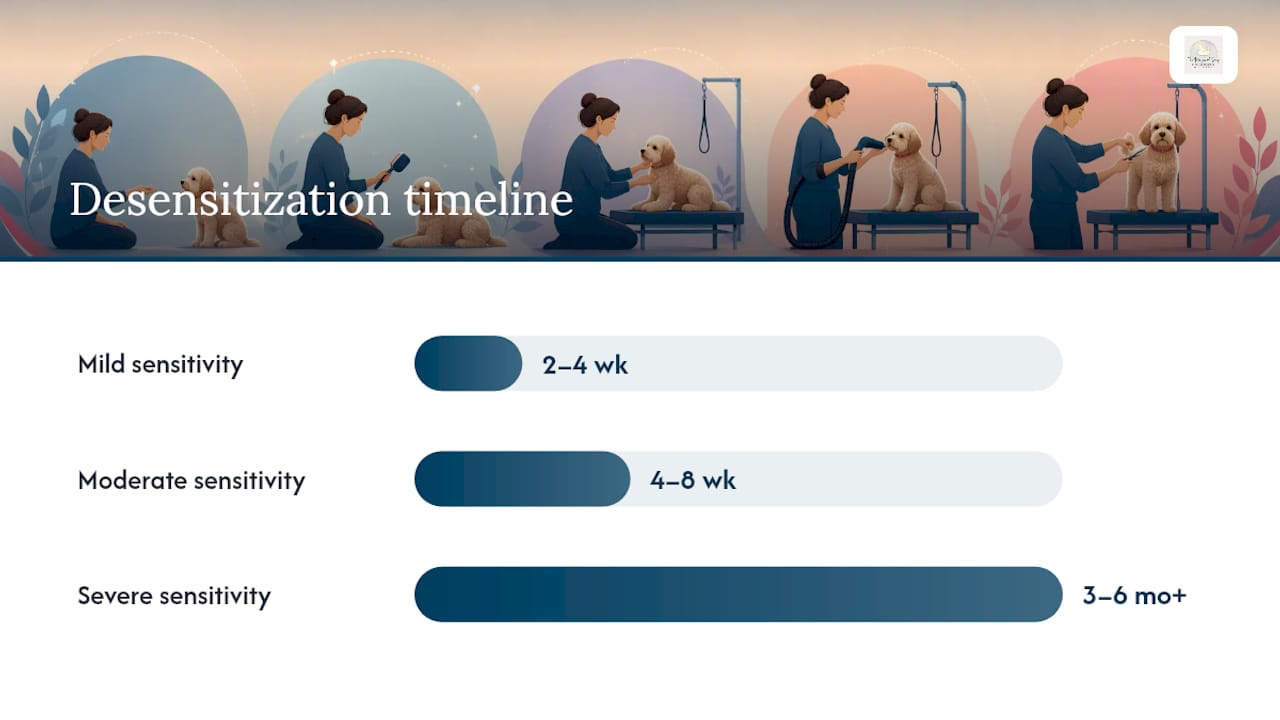
Timelines vary by severity. Mild sensitivity often eases in two to four weeks of daily five-minute sessions. Moderate cases typically take four to eight weeks. Severe, trauma-linked fear can take three to six months or longer, and often benefits from a structured plan built for rescue dogs with a professional’s guidance.
Mistakes that stall progress:
- Rushing to the next step before the current one is boring and easy.
- Using treats to lure the dog into a scary situation instead of rewarding calm exposure to it.
- Flooding, or forcing continued exposure until the dog “gives up,” which often produces shutdown rather than comfort.
Pro Tip: If your dog refuses a treat during a session, that’s information, not stubbornness. It usually means you’ve moved a step too fast.
What Is Cooperative-Care Grooming?
Cooperative care flips the grooming relationship. Instead of doing something to your dog, you invite your dog to participate, and honor it when they say “not yet.”
The Bucket Game is a simple entry point:
- Set a bowl or bucket of treats a few feet away and let your dog approach it.
- When your dog looks at the bucket, deliver a treat, then begin a light grooming touch.
- If your dog looks away from the bucket, stop immediately. That’s the signal.
- Resume only when your dog re-engages with the bucket on their own.
A chin rest works the same way. Teach your dog to rest their chin in your open palm for a treat. Once trained, the chin rest becomes their way of saying “I’m ready.” Lifting their chin away means “pause.” As PreventiveVet notes on cooperative care, these small consent behaviors reduce both stress and handling risk for everyone involved.
Pro Tip: If you work with a professional groomer, tell them about your dog’s stop signal in advance. Cooperative care only works if everyone honors it, not just you at home.
How Do You Introduce Grooming Tools Safely?
Each tool needs its own slow introduction, ideally at a moment when your dog is already relaxed.
- Brushes: Let your dog sniff it, reward that, then do a few strokes in a favorite spot before moving anywhere sensitive.
- Clippers: Run them nearby, off the body, and reward calm ears before ever touching the coat.
- Nail trimmers or grinders: Touch the tool to a paw with it powered off, reward, and only turn on a grinder once your dog tolerates the sound from a distance.
- Muzzles: Introduce as a treat-dispensing tool, never as a punishment, building up wear time gradually before any grooming task happens.
VCA Hospitals recommends using aromatic, high-value treats like small pieces of cooked chicken for this kind of work. Plain kibble simply doesn’t create as strong an association for a nervous dog.
Pro Tip: Practice with tools powered off far more often than you think you need to. Sound sensitivity is one of the most underestimated triggers in grooming anxiety.
How Should You Prepare for a Grooming Appointment?
Preparation starts well before you walk through the door.
At-home checklist:
- Schedule “happy visits” where your dog is greeted, treated, and leaves without any procedure.
- Brush a few minutes a day to prevent mats that would require longer, more invasive handling.
- Practice the same tool-introduction exercises you’d use for grooming day.
- Give your dog exercise beforehand so they arrive a little more settled.
Questions worth asking a groomer:
- How do you typically work with dogs who are nervous or new to grooming?
- What happens if my dog needs a break or shows signs of stress mid-session?
- Can we schedule during a quieter time of day?
Happy visits reduce negative location associations significantly, according to Best Friends’ handling research, which is why they’re worth the extra trip even without a groom attached.
Pro Tip: Ask for a minimum-viable groom on the first visit. A calm, partial session builds trust for a fuller one later.
When Should You Call a Vet or Behaviorist?
Some situations need more than a home protocol.
Red flags that warrant professional help:
- Biting, snapping, or any attempt to injure themselves or others.
- Panic responses like frantic escape attempts or uncontrolled trembling.
- No improvement after several weeks of correctly applied, consistent practice.
Start with your veterinarian to rule out pain, since a dog flinching at brushing may be reacting to an underlying medical issue rather than fear alone. From there, a certified trainer or veterinary behaviorist, ideally one connected to organizations like the AVMA or IAABC, can build a tailored plan. If medication becomes part of that plan, it should only ever be prescribed and dosed by your veterinarian.
Pro Tip: Bring a short video of your dog’s reaction to your vet appointment. It says more in fifteen seconds than most descriptions can.
How Long Does It Take to Fix Grooming Anxiety?
Progress timelines mirror the desensitization stages: two to four weeks for mild cases, four to eight weeks for moderate ones, and three to six months or more for severe, trauma-linked fear.
- Keep a simple log of each session’s length and your dog’s comfort level.
- Short phone videos help you spot gradual improvement that’s easy to miss day to day.
- Celebrate small wins, like tolerating one more nail than last week.
What Are the Safety Rules for Grooming at Home?
Home grooming sessions should stay short, calm, and low-risk for both of you.
- Use a non-slip mat or towel on any surface your dog stands on.
- Keep sessions under five minutes when anxiety is present.
- Never pin or physically force a struggling dog into position.
- If matting has already set in near the skin, stop and let a professional handle it rather than risk cutting your dog.
A dog who tenses at the sight of scissors near a mat is telling you something useful. Respecting that threshold, rather than pushing past it, keeps both of you safer and keeps trust intact for the next attempt.
Pro Tip: Between full grooms, a few minutes of daily brushing prevents the kind of matting that turns a routine touch-up into a stressful ordeal.
What Does Cooperative, Pet-Paced Grooming Look Like in Practice?
At The Pampered Pup, we’ve seen firsthand how a minimum-viable groom, split across two visits instead of forced into one, changes everything for a nervous dog. Paws and a sanitary trim on visit one. A gentle face trim on visit two, once the dog remembers the room as safe.
A dog who leaves the first visit calm, even with an unfinished groom, is far more likely to relax on the second visit than a dog who left in distress after a “complete” one.
Gulf Coast humidity, salt water, and sand only add to the grooming needs of local dogs, which means consistent, low-stress visits matter even more here than in drier climates.
Between visits:
- Practice paw handling for thirty seconds a day.
- Brush gently to reduce buildup from sand and humidity.
- Keep grooming words and tools associated with treats, not just appointment day.
Pro Tip: Ask your groomer about scheduling regular, shorter visits rather than infrequent long ones. Consistency does more for anxious dogs than any single “perfect” session.
A Calm Note From The Pampered Pup
We built our cage-free, pet-paced space because we believe grooming should never feel like something to survive. Our team works at each dog’s own rhythm, in an open room without cages, so trust builds naturally instead of under pressure.
Every dog we see, whether from Mobile, Daphne, Spanish Fort, or Fairhope, is treated like a member of someone’s family, because that’s exactly what they are.
How The Pampered Pup Supports Anxious Dogs
If your dog dreads grooming day, our cage-free, pet-paced approach was built with exactly that dog in mind. Unlike a rushed, kennel-based visit, we groom at your dog’s own speed in an open, supervised space, with no cages and no clock pressure.
Our services include full grooms, tidy-up trims, bath and brush sessions, de-shedding treatments (especially valuable through Gulf Coast shedding seasons), puppy first grooms, senior and sensitive-dog grooming, and our $19 Pampered Pup Package for a simple, low-stress start.
When you book your appointment, feel free to request a happy visit or a minimum-viable groom first. It’s a gentle way to introduce your dog to our space before a full session. Explore our full grooming services or call us at 251-776-2104 to talk through your dog’s specific needs.
Sources
- Cooperative Care for Dogs: Giving Your Dog Choice and Control - Whole Dog Journal
- How to help dogs tolerate grooming and vet handling - Best Friends
- Handling exercises for trimming nails and brushing teeth - VCA Hospitals
- Cooperative care and handling - PreventiveVet
FAQ
What can I do if my dog is too anxious to get groomed?
Start with a minimum-viable groom, just the essentials like paws or a sanitary trim, rather than forcing a full session, and build up through short desensitization practice at home.
What is the 3-3-3 rule for dog anxiety?
The 3-3-3 rule generally refers to a new dog needing about three days to decompress, three weeks to learn routines, and three months to feel fully settled; it’s most often applied to adjustment after adoption rather than a specific grooming protocol.
How do you calm an anxious dog for grooming?
Slow your movements, lower your voice, offer high-value treats like small pieces of cooked chicken, and take short breaks whenever stress signals appear.
How do you groom an unwilling dog?
Never force a struggling dog through a full groom; instead, use cooperative-care tools like the Bucket Game or chin rest so the dog can pause the process, and consider a pet-paced provider like The Pampered Pup that grooms in stages.
Recommended
- Beyond the Brush: Why Grooming Is Essential for Your Pet’s Well-Being | Mobile, AL
- Bath, Tidy-Up, or Full Groom? How to Know What Your Dog Needs | Mobile, AL
- Puppy & Senior Dog Grooming in Mobile, AL | The Pampered Pup
- Dog Grooming in Mobile, AL | Cage-Free Groomer | The Pampered Pup
Want a hand with this? We're a cage-free, pet-paced grooming salon on Oak Circle Drive East in Mobile, AL, with early drop-off from 7:30 AM Tuesday through Friday (8:30 AM Saturday). Book online or call 251-776-2104 and we'll build a plan around your dog.