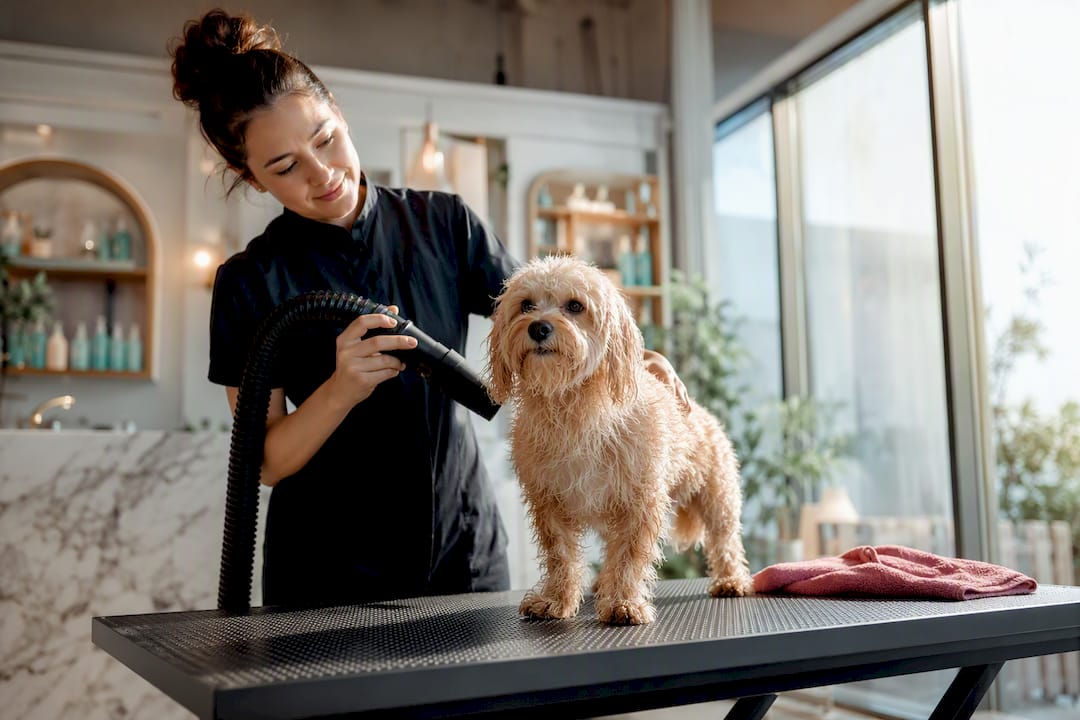

Cage drying dogs can be done safely, but only under strict, narrow conditions: constant human supervision, conservative low-heat settings, and a healthy dog with no breathing, heart, or age-related risk factors. For brachycephalic breeds, seniors, puppies, and dogs with respiratory or cardiac conditions, we believe cage-free, hand-supervised drying is the gentler and safer path. The sections below walk through how these dryers work, the real risks, and the alternatives worth knowing.
TL;DR:
- Cage drying should only be used with constant supervision, low-heat settings, and on healthy dogs without breathing or heart issues.
- At-risk dogs such as brachycephalic breeds, seniors, puppies, or those with respiratory conditions should avoid confinement-based drying altogether.
- Continuous visibility and a safety checklist, including emergency shutoff and regular equipment maintenance, are essential to prevent overheating and accidents.
- Alternatives like towel drying, hand-fluffing, and cage-free supervised drying are safer options for anxious or vulnerable dogs.
- Groomers and owners should tailor workflow choices to each dog’s needs, prioritizing safety and stress reduction over speed.
Table of Contents
- What Cage Drying Dogs Actually Involves
- The Real Risks: Overheating and Who Should Never Be Left in a Dryer
- A Safe-Use Checklist for Groomers and Owners
- Alternatives to Cage Drying and When to Choose Them
- Three Practical Drying Workflows
- Why We Choose Cage-Free, Supervised Drying
- Book a Cage-Free Groom With The Pampered Pup
- Sources
- FAQ
What Cage Drying Dogs Actually Involves
Cage drying is not one single piece of equipment. It is a category that covers a few different setups, and the differences matter more than most pet owners realize.
Cabinet or box dryers are enclosed units, often resembling a large kennel, that pump warm air through a sealed chamber to evaporate moisture from a dog’s coat. Cage-mounted air blowers attach to a standard kennel and blow air, sometimes warmed, into the space where the dog is confined. Both differ sharply from high-velocity table dryers, which use forceful room-temperature or slightly warmed air to physically push water off the coat while a groomer holds the nozzle and stays hands-on the entire time.
The mechanism behind cage drying is indirect evaporation: warm air plus steady airflow slowly lifts moisture out of the fur, similar to a gentle clothes dryer cycle. Cage dryers evaporate water by circulating warm air in an enclosed space, and they come in both cabinet and cage-mounted forms.
Groomers reach for cage dryers because they free up hands during a busy day. A few practical reasons this equipment stays popular in salons:
- It lets a groomer dry one dog while bathing or trimming another.
- Some dogs settle better with gentle warm airflow than the noise of a force dryer.
- It can finish drying a coat after most moisture is already removed by hand.
Used this way, as a finishing step rather than the whole process, cage drying carries far less risk than leaving a dog inside for the entire cycle unattended.
The Real Risks: Overheating and Who Should Never Be Left in a Dryer
Overheating is the central danger, and it happens faster than most owners expect. A confined space traps heat, and a dog’s core temperature can climb quickly with no way to escape the airflow if something goes wrong. A timer tells you when a cycle ends. It tells you nothing about whether a dog is struggling to breathe three minutes in.
That distinction is why industry guidance and experienced groomers advise that automatic timers are a backup only, with continuous, direct supervision as the actual safety measure.
Certain dogs should generally avoid traditional cage drying altogether:
- Brachycephalic breeds (French Bulldogs, Pugs, Boston Terriers, and similar short-nosed dogs), because their airway structure already limits heat tolerance
- Senior dogs with reduced heat regulation
- Very young puppies, whose temperature control is still developing
- Dogs with pre-existing heart or respiratory conditions
- Dogs with a seizure history, where heat stress can be a trigger
These at-risk groups face heightened danger from confinement-based drying, and reputable groomers screen for every one of them before a dog ever goes near a cage dryer.
News investigations have documented real tragedies tied to cabinet and kennel drying, including a CBS News review of grooming-related dog deaths linked to drying equipment misuse over the past decade. These cases are rare against the total number of grooms performed daily nationwide, but they are also the reason strict protocols exist at all. No checklist erases the risk entirely. It only narrows it to something manageable.
A Safe-Use Checklist for Groomers and Owners
If a groomer or owner does choose to use a cage dryer as part of a drying routine, the sequence below reduces risk at every stage.
- Screen the dog first. Ask about breathing history, heart conditions, age, and behavior around confinement before the dryer is ever turned on.
- Check breed and mobility. Confirm the dog is not brachycephalic, elderly, or a young puppy, and that it can lie down or stand comfortably in the space.
- Set conservative temperature and time. Because no single drying time is safe for every dog, start low and reassess based on coat density, humidity, and how the dog is responding.
- Maintain continuous line-of-sight supervision. A staff member should be able to see and hear the dog at all times, not just check in occasionally.
- Use the timer as a backup, never the primary control. The person watching the dog decides when the cycle ends.
- Keep fresh water within reach if the dryer session runs longer than a few minutes.
- Never muzzle a dog during drying. Panting is a dog’s primary cooling mechanism, and blocking it removes the one tool a dog has to regulate heat.
- Confirm the emergency shutoff works before every single use, not just during initial setup.
- Check filters, vents, and thermostat accuracy on a routine maintenance schedule, since a drifting thermostat can quietly turn “warm” into “hot.”
Pro Tip: Never route a stand or table dryer’s heat setting into a cage as a workaround. Cage-mounted units are calibrated for enclosed airflow; stand dryers are not, and mixing the two invites exactly the kind of uneven heat buildup this checklist exists to prevent.
Alternatives to Cage Drying and When to Choose Them
Cage drying is one tool among several, and it is rarely the best one for anxious, senior, or brachycephalic dogs.
- Towel-first drying removes a large share of retained water before any equipment touches the coat, cutting the time any dryer needs to run.
- High-velocity (force) drying works well on heavy double coats and blows loose undercoat free, though the noise and air pressure can overwhelm sound-sensitive or fearful dogs.
- Hand-fluffing with a brush and a handheld dryer gives a groomer full control and constant visual contact, ideal for dogs who cannot tolerate confinement.
- Cage-free supervised drying keeps the dog in an open space with a groomer at arm’s length the entire time, which is the approach we favor for our most anxious and at-risk clients.
- Behavioral desensitization introduces a dog gradually to dryer sounds and airflow over multiple visits, reducing long-term stress and the need for confinement-based methods at all.
Some salons combine these: towel and force-dry to pull out most of the moisture, then a brief low-heat finish, always with a person watching. Owners looking for a groomer experienced with anxious or reactive dogs can also look into mobile and in-home grooming options that skip cage-based equipment entirely.
Three Practical Drying Workflows
The right workflow depends on the setting and the dog. Here are three that hold up in practice.
- Salon staged approach (multiple dogs): Towel-dry each dog first, then move to high-velocity or a monitored box dryer with breathing and posture checks every few minutes, and finish the coat on the table with hand tools.
- One-on-one cage-free flow (our approach): Towel-dry, follow with low-heat table drying at close range, then hand-fluff to finish, with a groomer maintaining physical and visual contact from start to end.
- At-home owner routine: Towel-dry thoroughly, then use a low-noise handheld dryer on a cool setting or let your dog air-dry outside in shade, watching closely for any sign of distress before moving to the next step. If your dog shows heavy panting, wobbliness, or refuses to settle, stop and call a professional groomer for guidance.
Why We Choose Cage-Free, Supervised Drying
At The Pampered Pup, every dog dries within arm’s reach of a trained groomer, never inside a kennel. This one-on-one approach protects our most vulnerable guests: anxious pups, brachycephalic breeds, seniors, and first-time puppies who need patience, not confinement. Our staff trains through the Pampered Pup Grooming Academy, so every groom follows the same gentle, watchful standard.
— Martha Traweek
Book a Cage-Free Groom With The Pampered Pup
Gulf Coast humidity means every dog who walks through our door, whether they have spent the afternoon at the beach or just shed a season’s worth of coat in your backyard, needs a thorough, unhurried dry. The Pampered Pup never uses cages or kennels for any part of a groom, including drying. Every bath and brush, full groom, de-shedding treatment, and puppy or senior appointment finishes with hands-on, supervised drying at your dog’s own pace.
For families with brachycephalic breeds or older dogs who need extra care, our senior and puppy grooming services are built around exactly the caution this article describes. First-time visitors can also ask about our $19 Pampered Pup Package to see our cage-free approach firsthand.

Book online or call 251-776-2104 to schedule a soothing, cage-free groom for your dog in Mobile, Daphne, Spanish Fort, or Fairhope.
Sources
- PetEdge — Dog dryers overview
- Are cage dryers safe for dogs? — Rover
- 10 tips for danger-free drying — Groomer to Groomer
- Cabinet dryer safety — ABK Grooming
FAQ
What Is a Cage Dryer for Dogs?
A cage dryer is a cabinet, box, or cage-mounted unit that circulates warm air around a confined dog to evaporate moisture from the coat after a bath.
What Is the Hardest Breed of Dog to Groom in Terms of Drying?
Brachycephalic breeds like French Bulldogs and Pugs are among the hardest to dry safely, since their airway structure already limits heat tolerance before any dryer is involved.
How Do Groomers Dry Dogs So Fast?
Most professional groomers towel-dry first, then use high-velocity force dryers to blow water and loose undercoat out quickly, reserving cage or cabinet time for a brief, supervised finish rather than the whole process.
What’s the Fastest Safe Way to Dry a Dog?
For most healthy dogs, towel-drying followed by high-velocity force drying removes moisture fastest; for anxious, senior, or brachycephalic dogs, cage-free hand-fluffing at a slower pace is the safer choice even if it takes longer.
Recommended
- One-on-One Dog Grooming: Cage-Free Care for Mobile Dogs
- Cut Loose Fur 60–80%: Gulf Coast Deshedding for Dogs
- Summer Coat Care in Mobile, AL: Should You Shave?
- Senior Dog Grooming: A Safe, Gentle Guide
Want a hand with this? We're a cage-free, pet-paced grooming salon on Oak Circle Drive East in Mobile, AL, with early drop-off from 7:30 AM Tuesday through Friday (8:30 AM Saturday). Book online or call 251-776-2104 and we'll build a plan around your dog.