

Dog daycare delivers three real benefits for most dogs: consistent exercise, structured socialization, and mental enrichment that home routines rarely match. The AKC and AVMA-aligned guidance both support supervised group play as sound for canine welfare. The caveat matters just as much as the promise: results depend on your dog’s temperament, health, and the quality of the facility, including its vaccination checks and staff training.
TL;DR:
- High-energy and social dogs benefit most from daycare’s structured exercise and socialization, while anxious or reactive dogs often need quieter, private arrangements.
- Well-trained staff and proper grouping are crucial, as poor management can reinforce anxiety or bad habits despite the facility’s size or amenities.
- Regular mental challenges through scent games and puzzles help dogs respond better to commands and settle more quickly at home.
- Vaccination proof and temperament assessments are standard requirements to ensure safety and appropriate group placement.
- Scheduling trial half-days and observing your dog’s behavior afterward provides better insight into suitability than marketing or facility features alone.
Table of Contents
- What Are the Main Dog Daycare Benefits?
- How Daycare Supports Your Dog’s Body
- Social and Behavioral Benefits Owners Notice at Home
- Mental Enrichment: Why a Tired Mind Matters as Much as Tired Legs
- Which Dogs Thrive at Daycare, and Which Need a Different Plan
- Vaccinations, Screening, and Daily Safety Protocols
- What to Look For on a Facility Visit
- The Pampered Pup’s Approach to Play and Rest
- Why This Matters More Than the Marketing Suggests
- Ready to See the Cage-Free Difference in Mobile?
- Sources
- FAQ
What Are the Main Dog Daycare Benefits?
Owners in Mobile often ask us which benefits matter most for their particular dog. The honest answer: it depends on the dog, but most families see gains in several of these areas at once.
- Socialization: repeated, supervised play teaches dogs to read body language and manage excitement around other dogs. Best for social, playful breeds.
- Exercise: structured group play burns energy that a single leash walk cannot. Best for high-energy dogs and those prone to weight gain.
- Mental stimulation: scent games and novel environments tire the brain, not just the body. Best for bored or destructive dogs.
- Routine: a predictable schedule calms anxious dogs and supports training consistency. Best for puppies and newly adopted dogs.
- Reduced separation anxiety: companionship replaces isolation during the workday. Best for dogs who struggle when left alone.
- Early issue detection: attentive staff often notice a limp or ear irritation before an owner does.
- Complementary grooming: active play days go easier on the coat when paired with regular bath and brush upkeep.
How Daycare Supports Your Dog’s Body
A supervised daycare session, typically lasting between a half hour and an hour of active group play, provides far more sustained movement than most at home dogs get from a single walk around the block. That difference adds up over a week.
Regular activity is tied to healthier weight and joint function, and structured play and enrichment reduce boredom driven destructive behavior while supporting overall activity levels. Dogs carrying extra weight put more strain on hips and knees, so consistent movement matters more than any single long walk.
Quick fact: many daycare providers, including ours, plan rest breaks between play sessions, which matters even more along the Gulf Coast, where heat and humidity make outdoor exertion riskier during peak afternoon hours. A well-run daycare paces activity around the temperature of the day, not just the clock.

Social and Behavioral Benefits Owners Notice at Home
Dogs learn social skills the same way children do: through repetition. A dog who plays alongside the same group several times a week starts to recognize warning signals, like a stiff tail or a hard stare, long before a scuffle breaks out.
Owners often report calmer greetings at the door, less leash reactivity on walks, and fewer barking spells when the doorbell rings. Those changes come from practice, not luck.
None of this happens automatically. Grouping matters. A facility that mixes an anxious dog with a rowdy pack, or lets an inexperienced staff member manage ten dogs alone, can just as easily teach bad habits as good ones. The skill of the humans in the room shapes the outcome as much as the dogs themselves.
Mental Enrichment: Why a Tired Mind Matters as Much as Tired Legs
Physical exercise wears out muscles. Enrichment wears out the brain, and the two produce different kinds of calm at home.
Quality programs build in scent games, puzzle toys, and structured obstacle activities that ask a dog to problem solve, not just run. A dog who spends an hour sniffing out treats hidden in a play yard often settles faster that evening than one who simply chased a ball.

This distinction shows up in training, too. Dogs given regular mental challenges tend to respond to commands more readily than dogs given exercise alone, likely because they have practiced focusing and self control in a stimulating setting.
Which Dogs Thrive at Daycare, and Which Need a Different Plan
Confident, social dogs with moderate to high energy tend to do best in a group setting. Puppies benefit too, provided introductions are gradual and supervised, since the AKC points to careful timing as essential for young dogs still learning social rules.
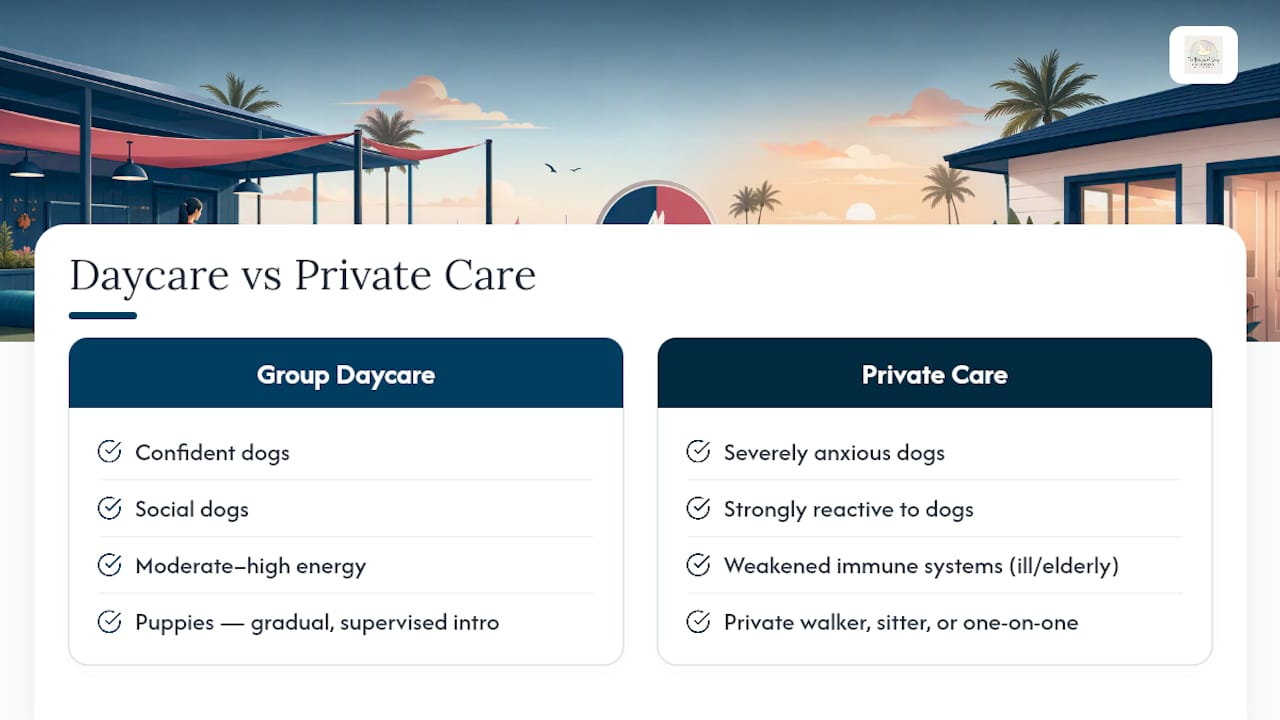
Dogs with severe anxiety, strong reactivity toward other dogs, or immune systems weakened by illness or age often fare better with a private walker, a sitter, or a quieter one-on-one arrangement. A veterinary behaviorist can help you decide. When in doubt, ask about a trial half-day before committing to a full schedule.
Vaccinations, Screening, and Daily Safety Protocols
A trustworthy facility protects every dog in its care, and that starts before the first visit. Reputable daycares require proof of core vaccinations and often run a short assessment to understand each dog’s temperament before grouping begins.
- Rabies, DHPP, and Bordetella records are commonly required, and most facilities ask that shots be current well before the first day to ensure immunity, per veterinary guidance on daycare safety.
- Temperament assessments typically last between half an hour and an hour and help staff decide which play group fits your dog best.
- Ask how dogs are grouped, what the rest policy looks like between play sessions, and what happens if a dog shows signs of illness during the day.
What to Look For on a Facility Visit
Numbers matter more than a friendly greeting at the front desk. Before you commit, walk through the space and ask direct questions.
- Confirm how vaccination records are verified, not just collected on paper.
- Ask the staff to dog ratio and how groups are supervised during active play.
- Ask what the emergency plan is if a dog is injured or becomes ill.
- Watch the dogs already there. Relaxed bodies and open mouths are good signs; pinned ears or stiff postures are not.
- Look for a separate, quiet rest space apart from the main play area.
Pro Tip: Schedule a trial half-day before enrolling full time, then watch your dog’s behavior at home for the following 48 hours. A dog who sleeps deeply and eats normally has likely had a good experience; one who seems unsettled or unusually clingy may need a smaller group or a slower introduction.
The Pampered Pup’s Approach to Play and Rest
At The Pampered Pup, every dog moves at their own pace, in an open, cage free space, never a kennel. We believe supervised, unhurried play is part of what makes a dog feel truly cared for, not just occupied.
Our team pairs relaxed group time with the grooming services families already trust us for, including de-shedding treatments that help with the Gulf Coast’s year-round shedding season and gentle care for puppies and senior dogs. One-on-one attention means we notice when a dog needs a quieter moment.
If you would like to see our space in person, reach out and book a visit or call 251-776-2104.
Why This Matters More Than the Marketing Suggests
Most daycare marketing leans on the word “fun,” which undersells what is actually happening. The real value is behavioral: dogs practice self-regulation in a way that leash walks and backyard time simply cannot replicate.
The conventional advice, that any daycare is better than none, falls short. A poorly staffed facility with weak grouping practices can reinforce anxiety or reactivity just as easily as a well-run one builds confidence. The research consistently points back to staff skill and group management as the deciding factor, not the size of the play yard or the number of toys on the floor.
If you take one thing from this guide, prioritize the trial visit over the sales pitch. Watch how staff move through the room, how they separate mismatched dogs, and how your own dog behaves once you get home. That 48 hour window tells you more than any brochure will.
— Martha Traweek
Ready to See the Cage-Free Difference in Mobile?
Traditional boarding kennels rely on cages and rigid schedules. The Pampered Pup takes a different approach: an open, supervised space where your dog moves at their own pace, never rushed into a crate or a group they are not ready for.
This fits naturally with everything covered above. Our team pairs relaxed daycare time with grooming your dog already needs, from a de-shedding treatment after a sandy beach day to a gentle senior groom for an older family member.
We serve Mobile, Daphne, Spanish Fort, and Fairhope. If you are ready to bring your dog in for a trial visit or a full groom, book online or call 251-776-2104.
Sources
- Dog daycare: what to ask, vaccine requirements and safety — MVet Hospital
- Is Dog Daycare Good For Dogs? — PAWS
- Is dog daycare right for your puppy? — AKC
FAQ
What are the benefits of dog daycare?
The main benefits are reliable exercise, structured socialization, and mental enrichment, which together tend to reduce destructive behavior and support calmer evenings at home.
What are the downsides of doggy daycare?
Poor grouping, weak staff to dog ratios, and inconsistent rest policies can turn daycare into a stressful experience rather than a beneficial one, so facility quality matters as much as the concept itself.
Is it healthy for dogs to go to daycare?
For social, healthy dogs, regular daycare attendance supports activity levels and behavioral health, though dogs with severe anxiety, reactivity, or weakened immune systems often do better with a quieter, one-on-one care option.
How often should a dog go to daycare?
Two to three days a week is a common recommendation, balancing social exposure with rest days rather than daily attendance for every dog.
What vaccines does my dog need before starting daycare?
Most facilities require proof of Rabies, DHPP, and Bordetella vaccines, current at least two weeks before the first visit.
Recommended
- Dog Beach Grooming: What Coastal Dog Owners Need to Know
- Why Grooming Matters for Your Pet’s Well-Being
- Cut Loose Fur 60–80%: Gulf Coast Deshedding for Dogs,…
- Summer Coat Care in Mobile, AL: Should You Shave?
Want a hand with this? We're a cage-free, pet-paced grooming salon on Oak Circle Drive East in Mobile, AL, with early drop-off from 7:30 AM Tuesday through Friday (8:30 AM Saturday). Book online or call 251-776-2104 and we'll build a plan around your dog.