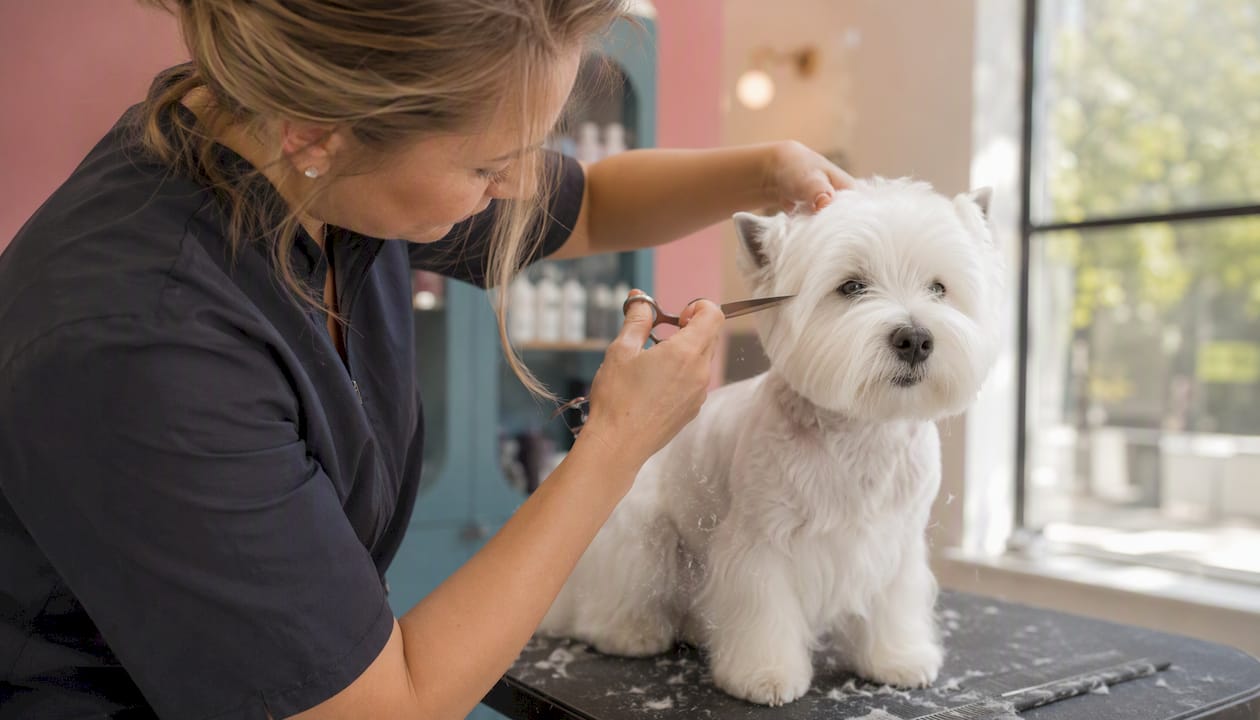

The five most common Westie grooming styles are the Westie cut, Show cut (hand-stripped), Puppy cut, Natural/pet cut, and the Tidy-up trim. The single best rule for choosing between them: match the maintenance level to your lifestyle and your dog’s comfort, not the other way around.
- Westie cut — the classic breed silhouette with a rounded head and skirted body; medium maintenance, pro groom every 4–6 weeks. Best for most pet owners.
- Show cut (hand-stripped) — preserves the harsh, wiry outer coat and bright white color; high maintenance, pro groom frequently every few weeks. Best for conformation dogs or owners committed to traditional texture.
- Puppy cut — a uniform short trim all over; low maintenance, pro groom every 6–8 weeks. Best for puppies, seniors, or active outdoor dogs.
- Natural/pet cut — follows the coat’s natural growth with minimal shaping; low to medium maintenance. Best for owners who prefer a softer, relaxed look.
- Tidy-up trim — a between-grooms touch-up on face, paws, and sanitary areas; low maintenance. Best as a supplement to any of the above.
If you’re local to Mobile, Daphne, Spanish Fort, or Fairhope, scroll to The Pampered Pup section for breed-specific booking details.
Key Takeaways
Choosing the right Westie grooming style comes down to one honest question: how much maintenance can you and your dog realistically sustain between professional appointments?
| Point | Details |
|---|---|
| Match style to lifestyle | Choose a style based on your brushing routine and your dog’s comfort, not aesthetics alone. |
| Pet groom frequency | Most clipped pet Westies need a professional groom every 4–6 weeks; hand-stripped pets every 8–12 weeks. |
| Brush several times a week | Brush 2–3 times weekly (daily during heavy moult) to prevent mats and keep the coat healthy. |
| Gulf Coast care | Rinse salt and sand after beach outings; favor shorter clips in summer to manage heat and humidity. |
| The Pampered Pup | Cage-free, breed-specific Westie grooms in Mobile, AL, with hand-stripping, clipper options, and the $19 Pampered Pup Package. |
Table of Contents
- What are the most popular Westie grooming styles?
- Hand-stripping vs. clipping: which technique is right for your Westie?
- How to care for your Westie’s coat between professional grooms
- How do you choose the right Westie haircut style?
- How often should you schedule professional Westie grooms?
- What to expect at a Westie groom with The Pampered Pup
- Common grooming mistakes to avoid with each Westie style
- Benefits and drawbacks of each Westie style for coat health and comfort
- A groomer’s note on style choices and your dog’s wellbeing
- Book a Westie groom at The Pampered Pup in Mobile, AL
- Sources
- FAQ
What are the most popular Westie grooming styles?
Every Westie style starts from the same double coat: a soft, dense undercoat beneath a harsh, wiry outer layer. How a groomer shapes and removes that outer coat determines the look, the texture, and how much work you’ll do between appointments.
Westie cut
The Westie cut is the breed’s signature pet look. The body coat is kept at a medium length, the legs are left slightly fuller to create a “skirt” effect, and the head is scissored into a rounded, chrysanthemum shape. The tail is shaped into the classic “carrot” profile, thick at the base and tapering to the tip. Thinning shears and selective hand-stripping on the head and legs help preserve wiry texture and prevent the soft, fuzzy look that repeated clipping alone can produce.
Show cut (hand-stripped)
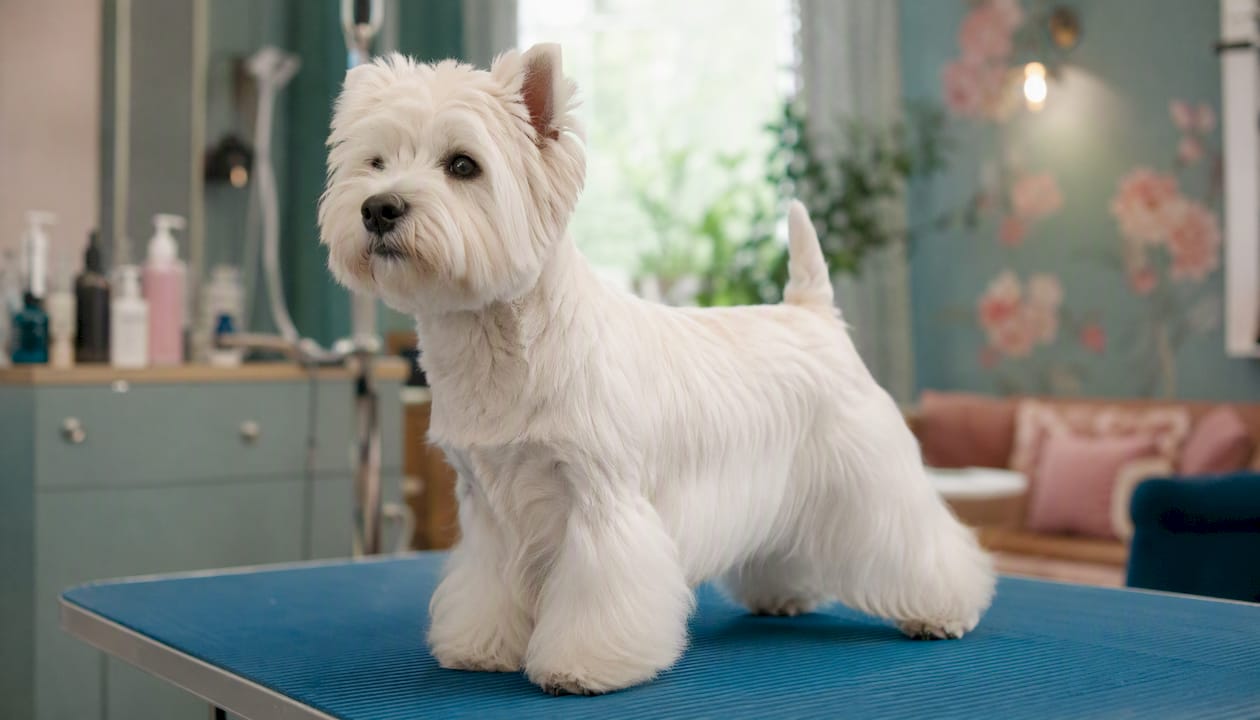
The Show cut is achieved entirely through hand-stripping, a technique where dead outer coat is pulled out by the root rather than cut. This preserves the coat’s natural pigment and harsh texture, keeping the white bright and the silhouette crisp. According to the AKC, show dogs typically need frequent grooming every few weeks to maintain this coat. It’s a significant time and financial commitment, but for owners who want the truest expression of the breed, there is no substitute.
Puppy cut
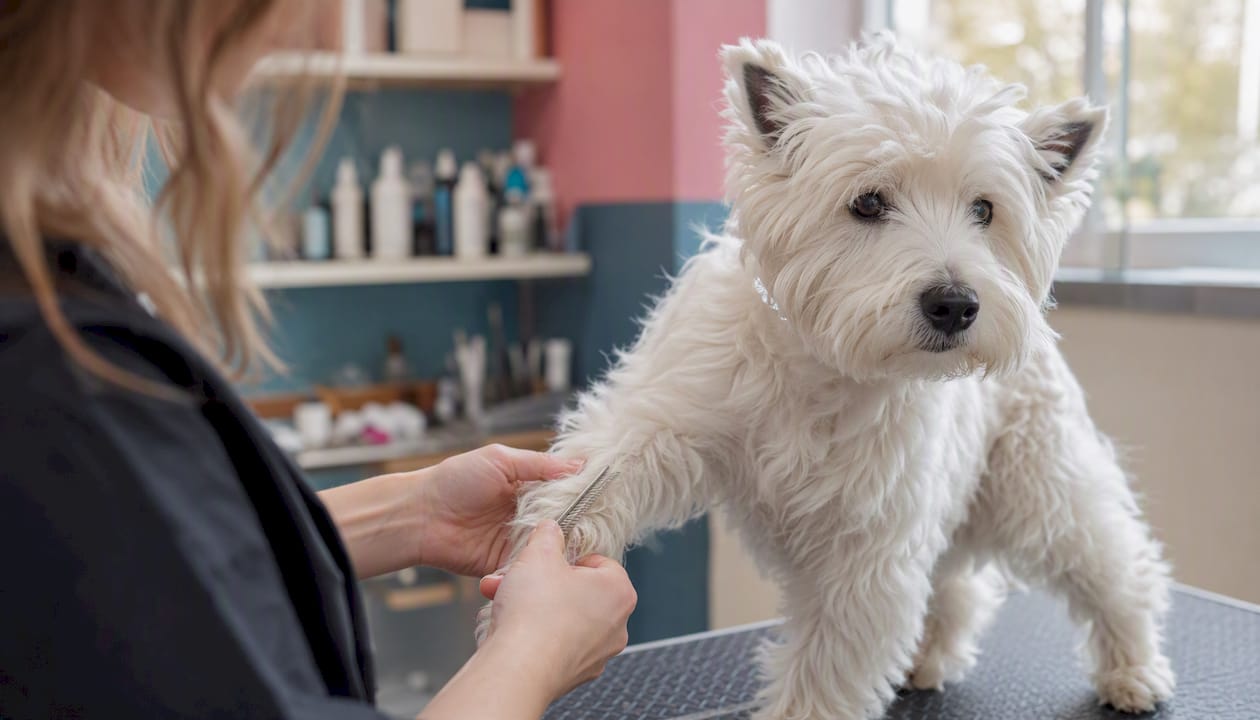
A Puppy cut clips the coat to a uniform short length all over, usually 1–2 inches. It’s the most practical choice for puppies still building positive grooming associations, for seniors with sensitive skin, and for active dogs who spend time in Gulf Coast sand and salt water. The look is soft and rounded rather than structured, and it’s the easiest style to maintain at home between appointments.
Natural/pet cut
The Natural cut follows the coat’s own growth pattern with light shaping rather than a defined pattern. It’s slightly longer and less sculpted than the Westie cut, with a relaxed silhouette. Owners who prefer a lower-key aesthetic and don’t mind a slightly shaggier look between grooms tend to favor this style.
Tidy-up trim
A Tidy-up is not a full style on its own. It’s a targeted touch-up: face, paws, ears, and sanitary areas are neatened without resetting the full coat. Scheduled between full grooms, it keeps your Westie comfortable and presentable without the cost or time of a complete appointment.
Style comparison
According to VCA Animal Hospitals, coat combing two to three times weekly and shaping every three months supports the Westie’s distinctive look. Show dogs are plucked and stripped, while pet dogs are commonly clipped.
Pro Tip: To preserve coat whiteness between grooms, use a whitening shampoo formulated for terriers and keep the beard dry after meals. Staining around the muzzle is easier to prevent than to reverse.
Hand-stripping vs. clipping: which technique is right for your Westie?
Hand-stripping is the traditional method for West Highland White Terriers and the only technique that fully preserves the coat’s natural wiry texture and bright white color. Clipping cuts the hair shaft rather than removing it at the root, which gradually softens the outer coat over repeated sessions. For a pet Westie whose owner prioritizes comfort and convenience, clipping is a perfectly sound choice. For a dog heading into the show ring, or for an owner who wants the truest breed texture, hand-stripping is the standard.
Professional video demonstrations show how skilled groomers set body pattern lines, select blades and blenders to mimic a hand-stripped look with clippers, and use thinning shears to avoid visible clipper lines. The result can be quite close to a hand-stripped appearance without the time investment.
Essential tools for Westie grooming
- Stripping knife or stripping stone — removes dead outer coat at the root; the core tool for hand-stripping
- Slicker brush — loosens tangles and removes loose undercoat during brushing sessions
- Metal comb — checks for mats and finishes the coat after brushing
- Thinning shears — blend and shape without leaving hard clipper lines, especially on the head and legs
- Clippers with interchangeable blades — the workhorse for pet clips; blade length determines coat length
- Blending shears — soften transitions between clipped and scissored areas
Safety and welfare notes
Home hand-stripping is possible for experienced owners, but it requires patience and a calm dog. Attempting it on a nervous or pain-sensitive Westie can create lasting negative associations with grooming. If your dog tenses, vocalizes, or tries to move away during stripping, stop and schedule a professional session. Always check the skin for redness or irritation after any stripping work, particularly around the neck and shoulders where the coat is densest.
How to care for your Westie’s coat between professional grooms
The three most important at-home tasks are regular brushing, beard and face spot-cleaning, and weekly ear and paw checks. Done consistently, these three habits prevent the matting, skin issues, and coat deterioration that make professional grooms harder and more expensive.
Westie Vibes recommends brushing 2–3 times weekly (daily during heavy moult), bathing every 3–6 weeks for healthy Westies, and scheduling professional full grooms every 6–8 weeks for clipped dogs. Dogster’s vet-verified guidance puts bathing at around every 6–8 weeks for most dogs, with more frequent baths for allergy-prone Westies. A brushing session takes roughly 10–15 minutes; a bath and dry runs 30–45 minutes at home.
Work through the coat in sections with a slicker brush, then follow with a metal comb to confirm you’ve reached the skin. Pay special attention to the armpits, behind the ears, and along the skirt, where mats form first. Run your fingers through the coat with your eyes closed — mats you miss visually are often easy to feel. Small, loose tangles can be gently worked apart with your fingers and a detangling spray. A mat that feels tight or close to the skin should go to a professional groomer rather than be forced apart at home, which can tear the skin.
Overbathing strips the natural oils that protect the Westie’s wiry outer coat, so resist the urge to bathe after every muddy walk. A quick rinse with plain water handles most surface dirt without disrupting coat health.
Ears should be checked weekly for redness, odor, or excess wax. Nails need grinding or clipping approximately monthly. A brief tooth-brushing session two to three times a week keeps dental health in check and is far easier to maintain than to restore once neglected.
Pro Tip: After any Gulf Coast beach or marsh outing, rinse your Westie thoroughly with fresh water to remove salt and sand before they work into the undercoat. White skin areas are also more susceptible to UV exposure, so limit midday sun on days when your dog is freshly clipped short.
For more guidance on bathing frequency specific to Mobile’s climate, our Mobile groomer’s bathing guide covers the seasonal adjustments that matter most here on the Gulf Coast.
How do you choose the right Westie haircut style?
The four core selection criteria are dog comfort and health, your maintenance capacity, your local climate, and your aesthetic or professional goals. Work through these before settling on a style.
- Is my Westie’s coat harsh or soft? A naturally soft coat will not produce a true hand-stripped texture no matter how often it’s stripped. Clipping or a Puppy cut is often the more honest choice for soft-coated dogs.
- Does my dog tolerate hand-stripping? Some Westies find it uncomfortable, particularly around the head and neck. If your dog shows stress signals during stripping, a clipper-based Westie cut or Puppy cut is kinder.
- How much time can I realistically commit to brushing? The Westie cut and Show cut both require brushing several times a week. If your schedule is unpredictable, a shorter Puppy cut reduces the risk of matting.
- What’s my climate? Gulf Coast heat and humidity favor slightly shorter clips and more frequent rinses. A long, full coat in Mobile’s summer holds moisture and heat against the skin.
- Am I preparing for a show? If yes, hand-stripping is the only option for conformation. If no, a well-executed clipper trim is entirely appropriate.
Red flags to watch for
- Frequent matting between grooms, which suggests the current style is too long for your brushing routine
- Skin redness or irritation after clipping, which may indicate blade sensitivity or an underlying skin condition
- A progressively softer, fluffier coat after repeated clipping, which signals that selective hand-stripping or a texture-preserving technique is needed
- Visible clipper lines or a patchy finish, which points to a groomer who may not be familiar with Westie coat structure
Booking prep
Bring two or three reference photos to your appointment: one showing the overall silhouette you want, one showing the head shape, and one showing the tail. Note your dog’s current brushing routine and any skin sensitivities. The more specific you are, the closer the result will be to what you pictured.
How often should you schedule professional Westie grooms?
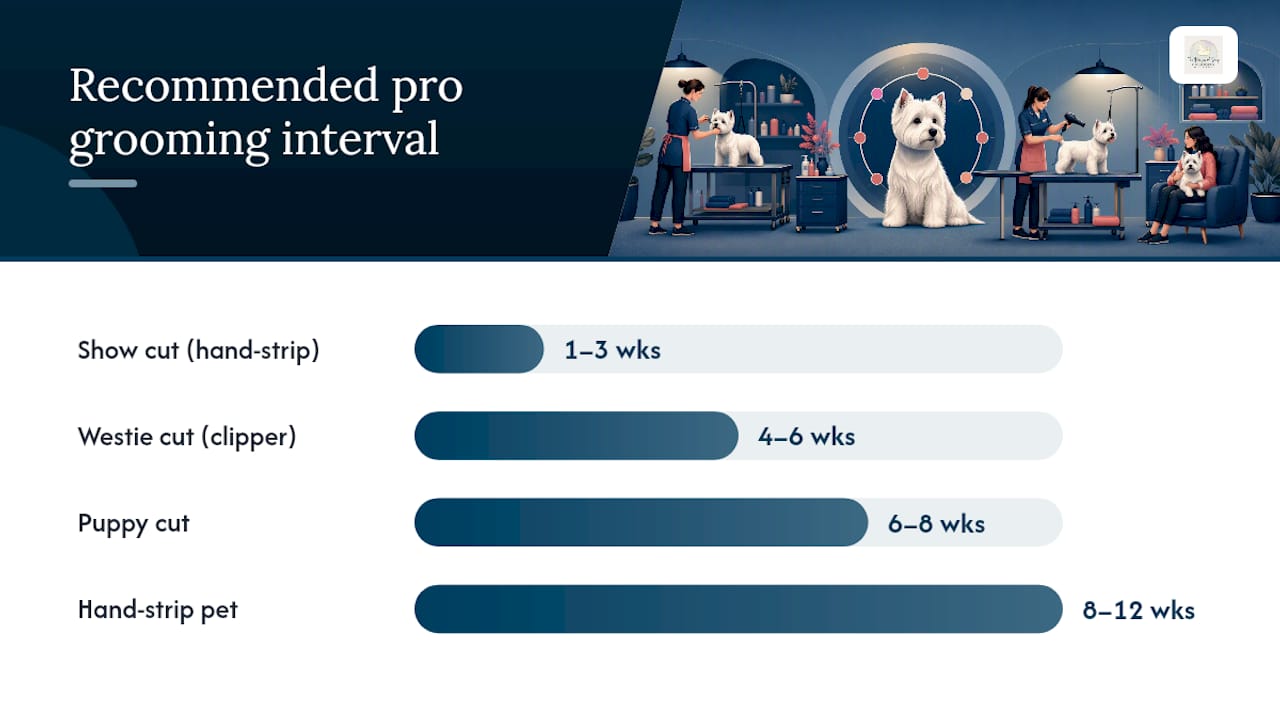
The AKC recommends professional grooming every 4–6 weeks for pet Westies and every 1–3 weeks for show dogs maintaining a hand-stripped coat. For hand-stripped pet dogs, a longer interval of 8–12 weeks is common because stripping removes the full growth cycle rather than just trimming the ends.
| Style | Recommended pro frequency | Technique | Notes |
|---|---|---|---|
| Westie cut (clipper) | Every 4–6 weeks | Clipper + scissor | Most common pet schedule |
| Show cut (full hand-strip) | Every 1–3 weeks | Hand-strip | Requires consistent rolling of the coat |
| Hand-strip pet | Every 8–12 weeks | Hand-strip | Longer interval; full coat cycle removed |
| Puppy cut | Every 6–8 weeks | Clipper + scissor | Easiest to maintain at home |
| Tidy-up trim | As needed (between full grooms) | Scissor + spot clipper | Not a replacement for a full groom |
Cost factors include the technique chosen (hand-stripping sessions run 3+ hours compared to 1.5–2 hours for a clipper groom), the groomer’s experience with terrier coats, the dog’s coat condition at arrival, and any add-ons such as de-shedding treatments, blueberry facials, nail grinding, or paw balm.
Pro Tip: A tidy-up trim scheduled between full grooms is a cost-effective way to keep your Westie’s face and paws neat without paying for a complete appointment. It also reduces the groomer’s prep time at the next full groom, which can lower the overall cost.
What to expect at a Westie groom with The Pampered Pup
Our approach is cage-free, pet-paced, and breed-specific. Every Westie that comes through our door at 711 Oak Circle Dr E, Suite B, Mobile, AL is greeted in an open, supervised space with no kennels and no rushing.
A typical Westie full groom at The Pampered Pup follows this sequence:
- Intake and breed assessment — we note coat condition, texture, skin health, and any sensitivities before we begin
- Pre-bath brush-out and de-shed — loose undercoat is removed before the bath so water and shampoo reach the skin
- Bath with coat-appropriate products — we use brightening and conditioning formulas suited to white terrier coats
- Blow-dry and comb-through — humidity-aware drying technique to prevent moisture from sitting in the undercoat, a real concern in Mobile’s climate
- Texture work — hand-stripping or clipper pattern-setting based on the style you’ve chosen, using thinning shears and blenders to achieve clean transitions
- Face, ear, and paw scissor work — the rounded head shape and carrot tail are finished by hand
- Finishing products and skin check — coat brightener, paw balm, and a final skin inspection
Our breed-specific grooming services include full grooms, tidy-up trims, de-shedding treatments, and puppy and senior grooming. The $19 Pampered Pup Package adds a blueberry facial, tooth brushing, deep coat conditioner, nail grinding, and paw balm to any appointment.
For puppies meeting the grooming table for the first time, we follow a gentle introduction process that builds trust before any tools come out. Our puppy and senior grooming page explains how we adapt handling for dogs at both ends of the age spectrum.
Bring reference photos and any notes about your dog’s coat history. We welcome the conversation.
Common grooming mistakes to avoid with each Westie style
Westie cut: The most frequent mistake is skipping thinning shears and relying entirely on clippers, which leaves hard lines and a flat, textureless finish. A second common error is clipping the head too short, which destroys the rounded silhouette that defines the breed.
Show cut: Rolling the coat inconsistently creates uneven texture across the body. Many owners also underestimate how often the coat needs attention between professional sessions, leading to a patchy, grown-out look before the next appointment.
Puppy cut: Clipping too short in summer without considering UV exposure on white skin is a real risk. Westies have pink skin beneath that white coat, and a very close clip in direct Gulf Coast sun can cause discomfort.
Natural/pet cut: Without regular brushing, the natural cut becomes a mat-prone style quickly. Owners who choose it for its low-maintenance appearance often find it requires more brushing than a shorter, more structured trim.
Tidy-up trim: Treating a tidy-up as a substitute for a full groom leads to coat buildup, hidden mats, and skin issues that are harder to address the longer they’re left. A tidy-up is a supplement, not a replacement.
Benefits and drawbacks of each Westie style for coat health and comfort
Westie cut offers a balanced middle ground. It preserves enough coat length to protect the skin while keeping the dog comfortable in moderate temperatures. The structured silhouette is achievable with clippers and thinning shears, making it accessible to most professional groomers. The drawback is that repeated clipping gradually softens the outer coat, which may require periodic selective hand-stripping to restore texture.
Show cut (hand-stripped) is the healthiest option for coat integrity. Removing dead coat at the root stimulates new growth, keeps the skin healthy, and maintains the natural pigment and harsh texture the breed was developed to have. The drawback is time and cost. Full hand-strip sessions run 3+ hours, and the frequency required for a show-ready coat is demanding for both dog and owner.
Puppy cut is the gentlest option for dogs with sensitive skin, anxious temperaments, or limited grooming tolerance. It reduces the risk of mat-related skin irritation and keeps the dog cool in warm weather. The trade-off is that the breed’s characteristic silhouette is largely lost, and the coat’s wiry texture softens more quickly with repeated close clipping.
Natural/pet cut causes the least disruption to the coat’s growth cycle. For dogs with naturally good coat texture, it can be a healthy choice. The risk is that without consistent brushing, the longer length becomes a liability, particularly in humid Gulf Coast conditions where moisture and debris collect in the undercoat.
Tidy-up trim has no meaningful drawbacks when used correctly as a between-grooms service. Its only risk is the misuse described above: relying on it as a full grooming substitute.
A groomer’s note on style choices and your dog’s wellbeing
Style should follow the dog, not the owner’s aesthetic alone.
We see this most clearly with senior Westies. A dog who tolerated hand-stripping comfortably at three years old may find it uncomfortable at ten, when skin becomes thinner and joints less flexible. Switching to a gentle clipper trim for an older dog is not a compromise — it’s the right call. Similarly, an anxious dog who tenses through every stripping session is telling you something. Clipping is not a lesser technique; for that dog, it’s the kinder one.
Skin that shows recurring redness, flaking, or irritation after grooming deserves a veterinary conversation before the next appointment. Grooming should leave your Westie refreshed and comfortable, not reactive. If a style or technique is consistently causing distress, a vet can rule out underlying skin conditions and help you and your groomer find an approach that works for your dog’s specific needs.
Book a Westie groom at The Pampered Pup in Mobile, AL
If you’re in Mobile, Daphne, Spanish Fort, or Fairhope and your Westie is due for a refresh, The Pampered Pup offers full Westie grooms and specialty trims in a calm, cage-free environment where your dog sets the pace.
Our services for Westies include full grooms with hand-stripping or clipper options, tidy-up trims, de-shedding treatments, and puppy and senior grooming. The $19 Pampered Pup Package, available as an add-on to any appointment, includes a blueberry facial, tooth brushing, deep coat conditioner, nail grinding, and paw balm. It’s a gentle, thorough way to send your Westie home feeling truly cared for.
We accept early drop-off from 7:30 AM Tuesday through Friday and 8:30 AM on Saturday. To book, visit us online or call 251-776-2104.
Sources
- West Highland White Terrier ‘Westie’ Facts You May Not Know | AKC
- How to Groom a Westie: 7 Vet-Verified Tips — Dogster
- West Highland White Terrier | VCA Animal Hospitals
- How to Groom a Westie at Home: Step-by-Step - Westie Vibes
- Part 2 of 6: Grooming a Pet Westie with a Show Dog Comparison — Learn2GroomDogs
- West Highland White Terrier Club of England — Grooming
FAQ
How should a Westie be groomed?
A Westie is groomed by brushing the double coat 2–3 times weekly, bathing every 3–6 weeks, and scheduling professional grooms every 4–6 weeks for clipped styles. The head is scissored into a rounded shape, the body is clipped or hand-stripped depending on the style, and the tail is shaped into a carrot profile.
What is the typical haircut for a Westie?
The most common pet haircut is the Westie cut: a medium-length body clip with a skirted silhouette, a rounded scissored head, and a tapered carrot tail. Show dogs use a fully hand-stripped coat to preserve the breed’s wiry texture and bright white color.
How often should a Westie be groomed professionally?
Most pet Westies on a clipper schedule need a professional groom every 4–6 weeks. Hand-stripped show dogs typically need attention every 1–3 weeks, while hand-stripped pet dogs can go 8–12 weeks between sessions.
What is the best grooming brush for West Highland Terriers?
A slicker brush is the standard first tool for working through a Westie’s double coat, followed by a metal comb to check for mats and finish the coat. For dogs being hand-stripped, a stripping knife or stripping stone is also part of the regular toolkit.
Recommended
- Dog Grooming Tips & Advice | The Pampered Pup Blog | Mobile, AL
- Breed-Specific Dog Grooming in Mobile, AL | Doodles, Poodles & More | The Pampered Pup
- Bath, Tidy-Up, or Full Groom? How to Know What Your Dog Needs | Mobile, AL
- Beyond the Brush: Why Grooming Is Essential for Your Pet’s Well-Being | Mobile, AL
Want a hand with this? We're a cage-free, pet-paced grooming salon on Oak Circle Drive East in Mobile, AL, with early drop-off from 7:30 AM Tuesday through Friday (8:30 AM Saturday). Book online or call 251-776-2104 and we'll build a plan around your dog.